21 August 2026
Bessent steps in on bonds — yields fall, gold and bitcoin rally
The week of August 17–21 was not about a new inflation print. It was about the Treasury market, and about Scott Bessent trying to stop a long-end selloff that had already pushed the Nasdaq through five red sessions. As Bloomberg’s wrap noted, US stock futures rose on Friday with the Nasdaq 100 looking to snap that slump — as yields steadied and bitcoin soared.
The core of the week is simple. After the 30-year yield touched a 19-year high near 5.34%, the Treasury said it would at least double liquidity-support buybacks of 10- to 30-year debt — from $2 billion to at least $4 billion per operation, starting September 9. The 30-year yield dropped about 10 basis points toward 5.19%; the 10-year fell toward 4.65%. The dollar weakened. Gold pushed through $4,500 and later toward the $4,580–4,600 area, a three-month high. Bitcoin jumped, finishing the week up around 22% and trading above $77,000. Equities were slower to join: they needed Friday’s rebound to stop the Nasdaq bleed.
The Bessent put, and why yields still matter
Bessent framed the move as market-making in a thin August tape, not as quantitative easing. The extra buybacks are small versus the stock of outstanding debt. The market did not care about the size. It cared about the signal: if the long end runs away again, Treasury is willing to lean against it. A day later Bessent told CNBC the operations “could be more than $4 billion per issue.” That is what traders started calling a “Bessent put.”
The first reaction was textbook. Long-end yields fell, the dollar slipped, and hard assets bid. Then Thursday showed the limits. Yields bounced as oil stayed elevated and investors asked whether a buyback program that starts in September can really cap a fiscal and inflation problem. By Friday the 10-year was back around 4.73% and the 30-year around 5.27% — lower than the week’s peak, higher than Wednesday’s low. The Nasdaq still managed to close the slump: Composite +0.43% to 26,180, S&P 500 +0.43% to 7,674, Dow +0.98% to 53,277. For the week, though, the S&P was still down about 1.4% and the Nasdaq about 2%.
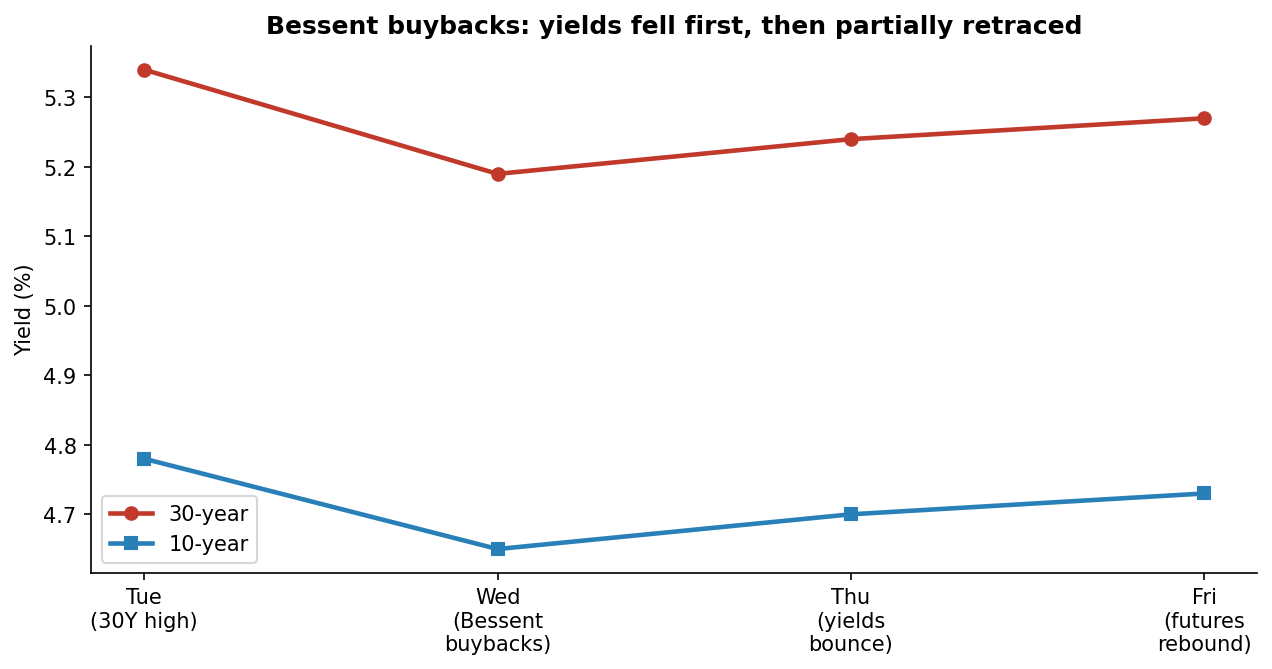
US Treasury yields around the Bessent buyback announcement. Source: Bloomberg / Reuters
The long end remains the constraint. A 10-year auction earlier this month already printed the highest yield since 2007. Oil and the Middle East keep an inflation bid under the curve. Bessent can support liquidity; he cannot erase the deficit. That is why gold and bitcoin reacted more cleanly than stocks. When Washington tries to manage the long end, the market now prices the dollar and hard assets in the same breath.
Gold, bitcoin, and a Friday equity bounce
Gold left last week’s $4,350–4,450 range and ran. The metal’s best read of the Bessent week is straightforward: lower real yields, a softer dollar, and a political willingness to buy bonds when yields get uncomfortable. That combination is why gold hit three-month highs even as some sessions saw yields bounce.
Bitcoin was the louder version of the same trade. A roughly 22% weekly advance lifted crypto-linked names — Coinbase, Strategy, Robinhood — and even helped Tesla, which is sitting on a large bitcoin book. For cross-asset traders, bitcoin holding up while the Nasdaq was still in a five-day slump was the tell that risk appetite had not gone fully defensive. It just rotated: out of stretched tech, into assets that benefit if Treasury has to keep supporting the long end.
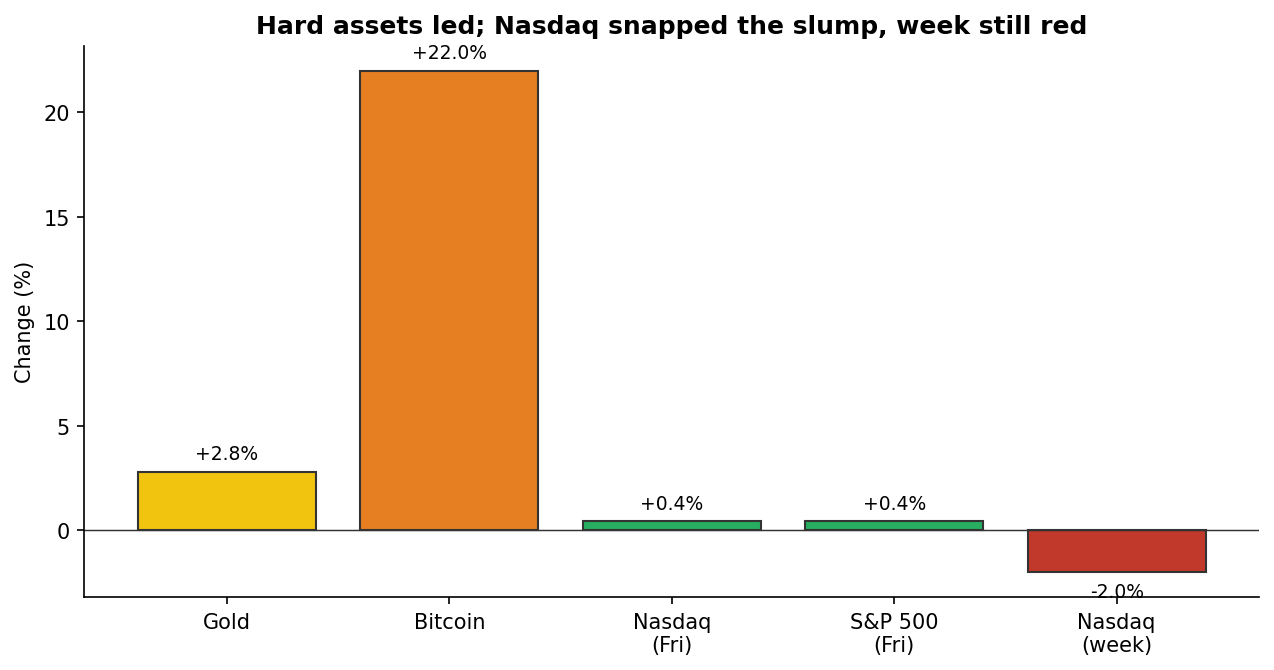
Hard-asset rally versus the Nasdaq’s weekly slump and Friday bounce. Source: Bloomberg / CNBC
Equities: Friday bounce, weekly loss — bonds still set the tape
By Sunday’s Bloomberg wrap, the stock story was already clear. US stocks rose on Friday and trimmed a shaky week, even as the bond market stayed jumpy and kept applying pressure. The S&P 500 gained 0.4% to 7,674 — only its second up day in the six sessions since the Aug. 13 record. The Dow jumped 518 points, or 1%, to 53,277. The Nasdaq added 0.4% to 26,180 and finally snapped its five-day slump. Breadth was positive. It was not enough.
For the week the S&P fell 1.4%, the Nasdaq 2%, the Dow 0.8% and the Russell 2000 1.6%. Both the S&P and Nasdaq snapped three-week winning streaks. Tech was the drag: information technology shed more than 3% over five days. Nvidia itself closed the week on a six-session losing streak, the longest since 2022. Semiconductors stayed heavy even on days when the tape tried to stabilize.
The split underneath the index was the same rotation already visible in gold and bitcoin. Crypto names led Friday — Robinhood +13.7%, Coinbase +8.2% — as bitcoin held above $77,000. Gold miners followed the metal: Freeport-McMoRan +7.6%, Newmont +3.1%. Healthcare had its best week since late June after Moderna and Merck’s late-stage melanoma data. Ross Stores rose 4.4% on a beat and tariff-refund tailwind. On the other side, Walmart had one of its worst weeks since 2022, Advance Auto Parts was crushed on earnings, and OSI Systems dropped 5.2% after Middle East delays hit deliveries.
The other lever — rates — did not cooperate. After Bessent’s buybacks, the 10-year was back at 4.73% on Friday, above the pre-announcement level. Analysts had said the Treasury move would likely be temporary; Friday confirmed it. Brent settled at $92.67 as Hormuz traffic stayed constrained, which is why yields could rise even on a green equity day. Jefferies’ David Zervos called the upsized buybacks a Treasury-led “Operation Twist,” not QE — useful for a thin August tape, not a substitute for a smaller deficit.
Weekend futures opened little changed to slightly lower, which fits a market that has stopped bleeding but has not found a new bid. The next test is this week’s cluster: July PCE on Wednesday, Nvidia after the bell the same day, Marvell on Thursday, and Warsh at Jackson Hole. Bloomberg reported over the weekend that Nvidia has told clients servers with Vera Rubin and Blackwell chips will see price hikes of more than 15% on early-2027 shipments, as memory costs surge. That can read two ways into the print — pricing power that protects margins, or a higher bill for hyperscalers that slows the capex cycle. Either way, stocks are no longer trading last week’s CPI calm. They are trading whether Bessent can keep the long end from running the equity tape.
News in focus
Monday, August 24: Bessent press conference — new Iran sanctions package.
Wednesday, August 26: July PCE; Nvidia earnings. High impact for both yields and the Nasdaq.
Thursday, August 27: Marvell earnings; Jackson Hole begins.
August 27–29: Warsh’s first symposium speech as chair. Still no forward guidance.
September 9: Treasury’s enlarged buybacks begin.
September 15–16: FOMC.
Now let’s shift to potential scenarios and trading ideas for the week ahead.
Gold
XAUUSD is no longer in the sideways box from mid-August. The Bessent announcement broke it higher, and the metal is now working the $4,500–4,600 area after a three-month high. As long as yields stay below this week’s peaks and the dollar does not reclaim its recent range, the path of least resistance is still up — a hold above $4,500 keeps the swing intact toward $4,650–4,700.
The risk is that Jackson Hole or a rebound in the 30-year back above 5.30% fades the “Treasury backstop” trade. In that case gold can slip back toward $4,400–4,450, last week’s ceiling and this week’s first support.
XAUUSD, daily chart. Source: Exness.com
Nasdaq
The Nasdaq finally snapped a five-day losing streak on Friday, but the weekly close is still lower and Sunday-night futures were slightly soft. The bounce was a function of a pause in yields plus crypto and healthcare leadership — not a new broad bid. Support now sits near 26,000–26,200. If that holds through PCE, Nvidia and Jackson Hole, a grind back toward 26,500–26,700 is the constructive case.
If the 10-year stays above the pre-Bessent level — or if Nvidia’s print and the 15% server-price story read as a capex tax rather than pricing power — the slump can resume, with 25,500–25,800 as the next downside area. The market is treating Bessent’s bond support as enough to stop the bleeding, not enough to restart the August melt-up.
USTEC, daily chart. Source: Exness.com