16 July 2026
Equities hold near records as CPI, Fed and earnings collide — AI faces fresh scrutiny
The week of July 14–18 in the financial markets has unfolded as one of the densest catalyst windows of the year. In the space of just three sessions, investors have absorbed a disinflationary CPI print, the first congressional testimony of Kevin Warsh as Fed chair, a wave of big-bank earnings, a soft PPI report, and — as of Thursday morning — a record TSMC quarter that failed to reignite the semiconductor rally. Through it all, the S&P 500 has hovered near record highs, yet the market's equilibrium remains fragile.
As Bloomberg noted in its markets wrap, equities traders appeared "largely unfazed" by the whirlwind of events — but beneath the headline calm, enormous dispersion is developing under the surface. Goldman Sachs posted its best day in a year; IBM suffered its largest daily decline since 1968. Chipmakers rallied on Tuesday, sold off on Wednesday, and stalled on Thursday despite TSMC's blowout results. The AI trade is no longer a monolith — it is a rotation machine, and that rotation is accelerating.
Tuesday, July 14: CPI delivers the week's first surprise
The June Consumer Price Index, released at 8:30 a.m. ET on Tuesday, was the dominant macro catalyst. Headline CPI fell -0.4% month-on-month — the first one-month decline in six years and the largest monthly drop since early 2020 — driven primarily by lower energy prices during a period of relative Middle East calm. On an annual basis, headline inflation eased to 3.5% from 4.2% in May. Core CPI held at 0.2% MoM, with the annual rate slipping to 2.6% from 2.9%.
The market reaction was immediate and cross-asset. Treasury yields bull-steepened, the US dollar softened, and rate-hike expectations were pared back sharply. CME FedWatch assigned roughly 83% probability to the Fed holding rates unchanged at the July 29 meeting — a dramatic shift from the hawkish pricing that had dominated in early July, when oil-driven inflation fears had pushed hike odds above 50%.
Equities caught a bid. The S&P 500 rose +0.38%, the Nasdaq Composite gained +0.90%, and the Philly Semiconductor Index (SOX) jumped +2.54% as chipmakers rebounded on the dovish repricing. Financials also advanced as the first wave of Q2 earnings landed: Goldman Sachs surged +9.00% on an earnings beat, JPMorgan rose +2.50% on record quarterly profits, and Bank of America gained +1.88%. The KBW Bank Index closed +1.05%.
But the equal-weight S&P 500 told a different story — it slipped -0.38% as a single name dominated the downside. IBM plunged -25.21%, its worst daily decline in available Bloomberg data going back to 1968, after missing analyst estimates and flagging a shift in enterprise spending away from its core software and consulting franchises. The move underscored a theme that would define the rest of the week: the AI trade is splitting into winners and losers, and the dispersion is extreme.
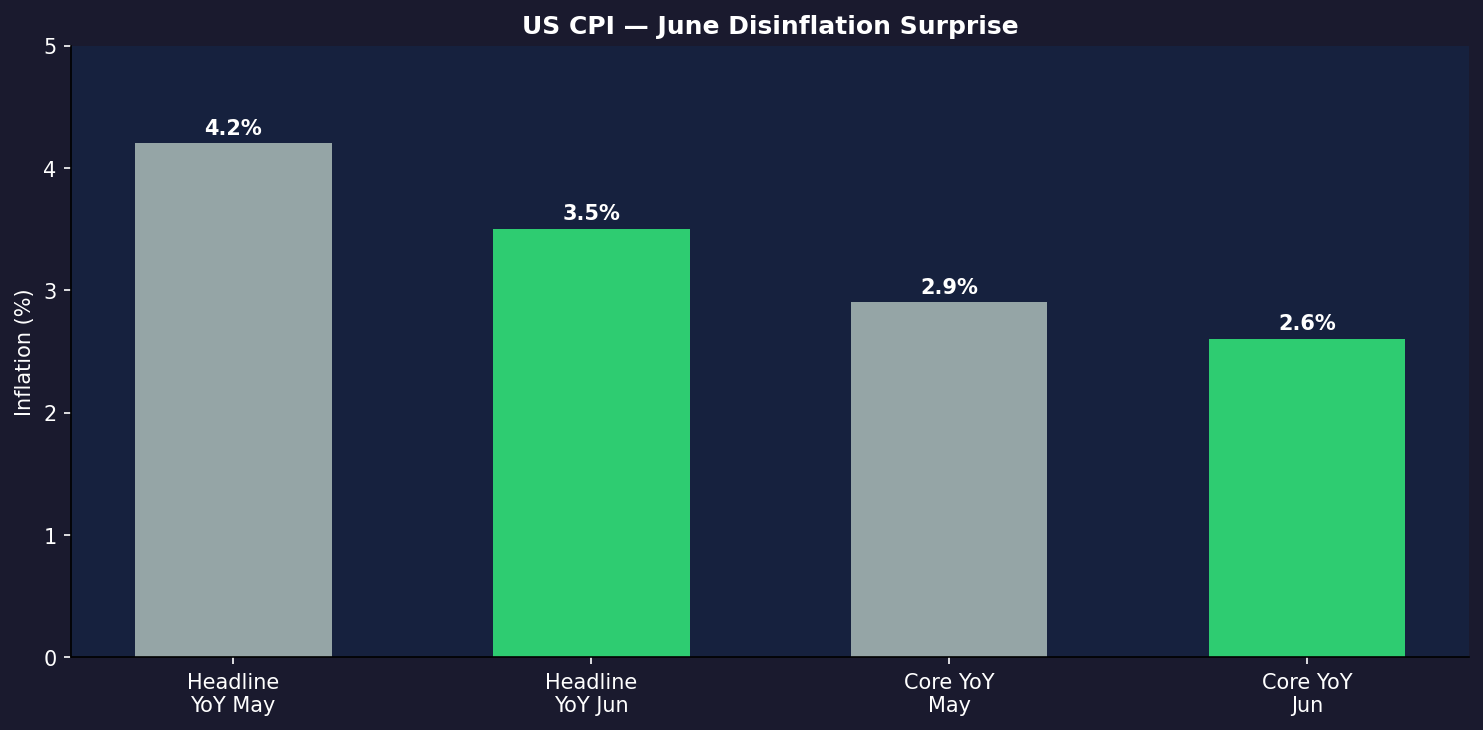
US CPI — June 2026 disinflation surprise. Source: US Bureau of Labor Statistics
Wednesday, July 15: PPI confirms the trend, Warsh stays cautious
Wednesday added two more layers to the narrative. The Producer Price Index for June fell -0.3% month-on-month, versus expectations for no change, with core PPI excluding food, energy and trade services rising a modest +0.1%. Annual producer inflation stood at 5.5%, but the monthly trajectory reinforced the disinflationary signal from Tuesday's CPI.
Kevin Warsh appeared before the Senate Banking Committee for the second day of his semiannual congressional testimony — his first formal appearance as Fed chair. His tone was deliberately measured:
- He welcomed the favourable inflation data but warned it is not "mission accomplished" on price stability.
- He described CPI and PPI as "imperfect measures of underlying inflation" and announced a Fed task force to examine how data agencies might improve reporting in an evolving economy.
- He avoided explicit forward guidance on the July 29 decision, but his comments — combined with the soft data — reinforced the consensus that no policy adjustment is imminent.
Markets priced accordingly. The probability of a July rate hike fell to roughly 10%, down from 31% a week earlier. OIS markets still price ~27 basis points of tightening by year-end, with the expected timing shifting toward December rather than September.
Equities advanced again, but the rotation beneath the surface intensified. The Dow rose +150 points (+0.29%) to 52,658.52, the S&P 500 gained +0.38% to 7,572.42, and the Nasdaq climbed +0.62% to 26,269.23. Apple hit an all-time high (+4.01%), with Amazon, Alphabet and Microsoft each rising approximately +3% as capital rotated out of semiconductor leaders and into megacap platform names.
The chip complex faced profit-taking: Micron fell -8.02%, SanDisk -8.12%, Intel -4.43%, and the Philly Semiconductor Index dropped -2.1%. Software names including ServiceNow also declined. The pattern was clear — investors are rotating within the AI trade, favouring platform and software exposure over hardware at current valuations.
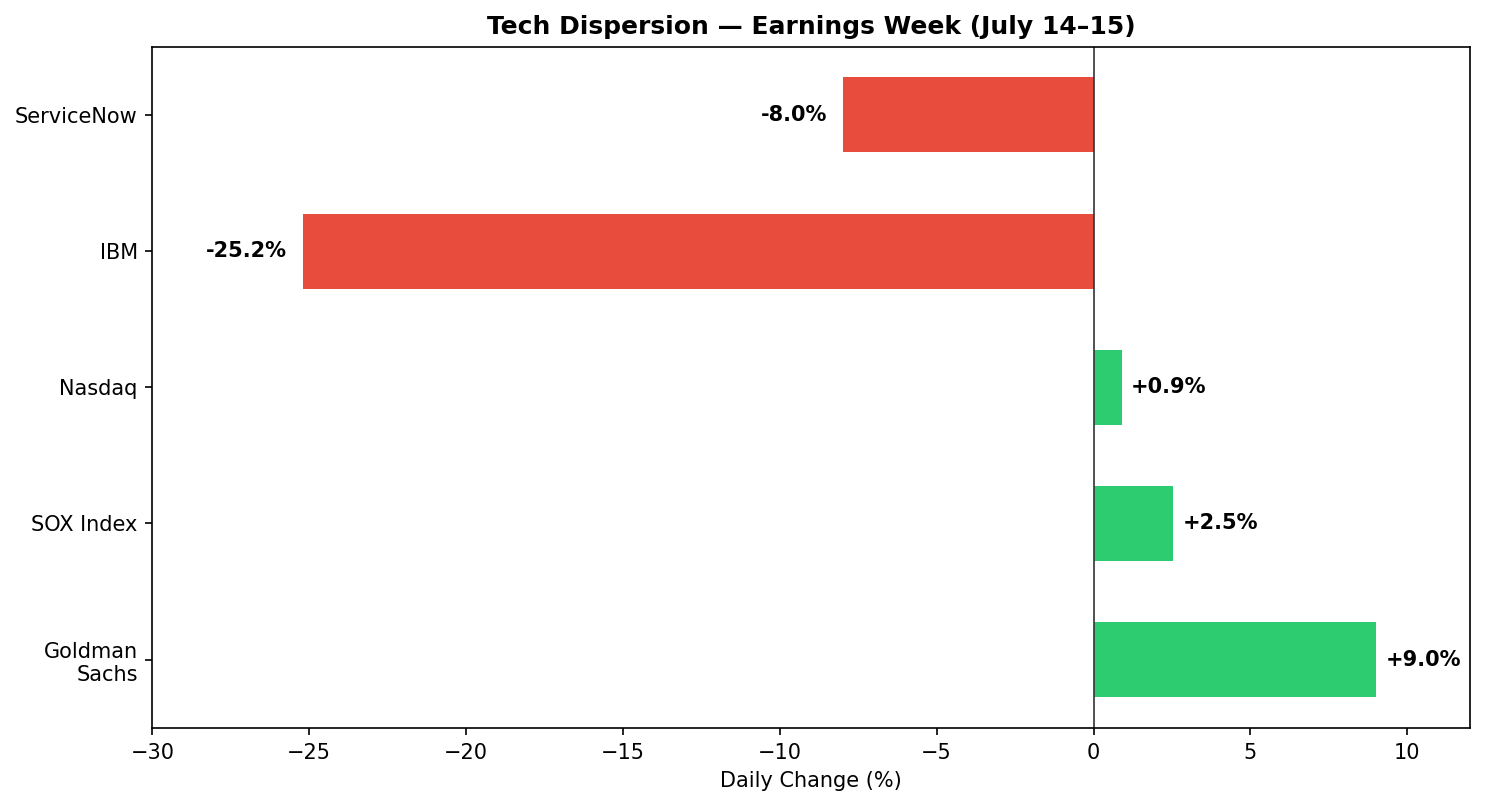
Sector dispersion — July 14–15, 2026. Source: Bloomberg / market data
Thursday, July 16: TSMC beats — but the AI rally stalls
Thursday opened with what should have been the week's most bullish corporate headline. Taiwan Semiconductor Manufacturing Co. (TSMC) reported record Q2 2026 results:
- Net profit surged +77.4% YoY to NT$706.6 billion (~$22 billion) — nine consecutive quarters of double-digit growth.
- Revenue rose +36% YoY to NT$1.27 trillion (~$40.2 billion).
- Gross margin reached 67.7%, driven by AI-related high-performance computing, which now accounts for 66% of total revenue.
- Management raised full-year revenue growth guidance to above 40% (from a prior target of above 30%).
- Capex guidance was lifted to $60–64 billion, with an additional $100 billion US investment announced to meet AI demand.
- Q3 revenue guidance of $44.6–45.8 billion came in roughly $2 billion above consensus.
And yet — the market shrugged. As Bloomberg reported in its Thursday markets wrap, "US Stocks Stall as AI Rally Faces Fresh Scrutiny": S&P 500 futures were little changed, Nasdaq 100 futures fell -0.2% to -0.4%, and chipmaking-related stocks were broadly lower in premarket trading despite the record print.
The reaction reflects a fundamental shift in the market's burden of proof. The debate is no longer whether AI demand is real — TSMC's numbers settle that question. The debate is whether current equity valuations already price in the full upside of the cycle, and whether AI hyperscalers are building more capacity than they will ultimately need. Bloomberg quoted Toni Meadows of BRI Wealth Management: "There's been a lot of rotation within the AI trade... It's probably a healthy thing to have consolidation. The further things go, the more stretched they get and then the reaction is bigger."
Asia set a cautious tone ahead of the US open. The MSCI Asia Pacific Index fell -1.4%, the KOSPI dropped sharply (extending its volatile year — three of its largest post-2008 declines have all occurred in 2026), and mainland Chinese equities lagged after Q2 GDP expanded +4.3% YoY, below the +4.5% consensus. Europe's Stoxx 600 fell -0.4%.
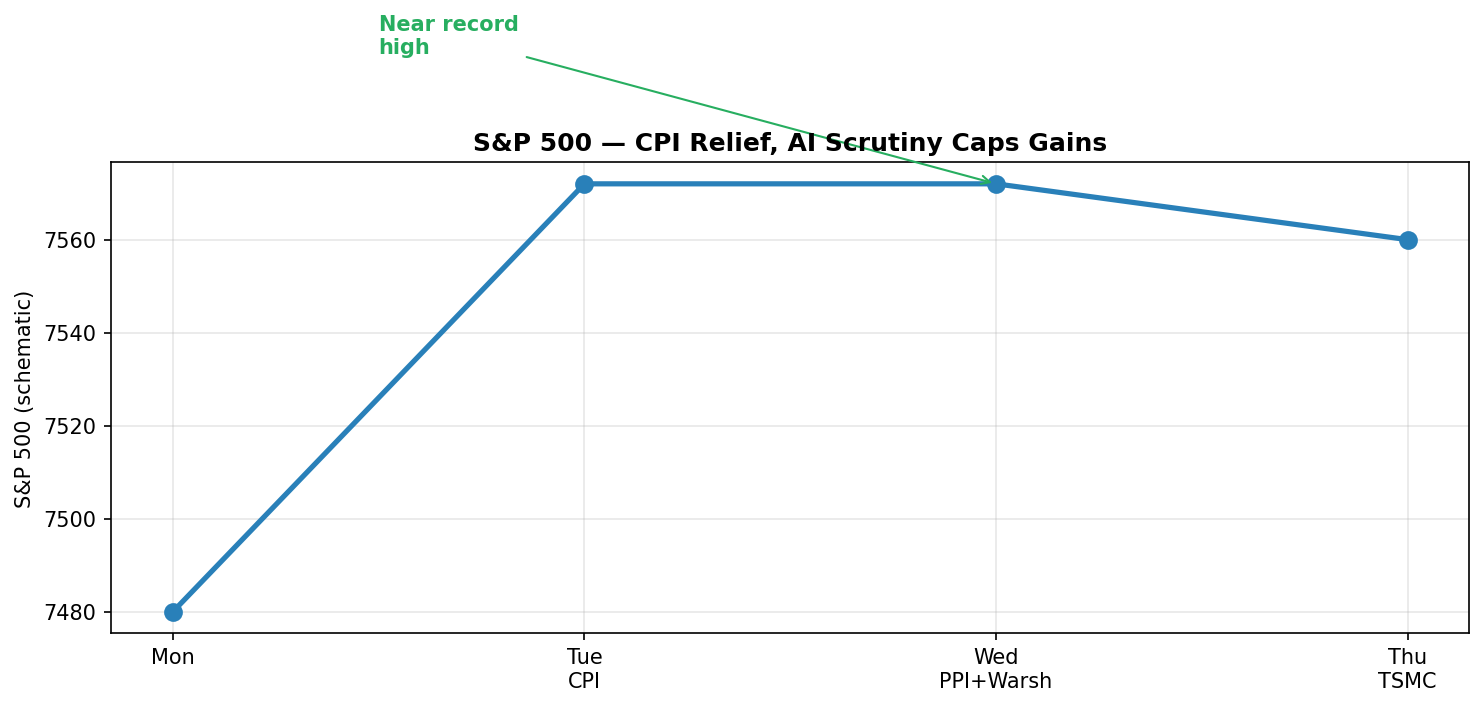
S&P 500 — week of July 14–16, 2026 (schematic). Source: Bloomberg
Middle East: the oil bid that CPI could not fully erase
Throughout the week, a competing narrative has persisted beneath the disinflationary macro data. The US–Iran conflict has not fully de-escalated since the July 8–9 flare-up, and oil prices have retained a bid even as CPI and PPI reflected lower energy costs during the brief calm period.
Investing.com noted that while soft inflation provided breathing space for the Fed, "a renewed flare-up in the Middle East" limited the follow-through in yields and the dollar. Oil's resilience means the energy pass-through risk for the July 14 CPI reading (next month's print) remains live — particularly if Hormuz shipping disruptions resume. Warsh himself acknowledged during testimony that the Iran conflict keeps policymakers alert for renewed energy price shocks.
For the July 29 FOMC meeting, this creates a two-sided risk: soft June inflation argues for a hold, but elevated oil and Warsh's price-stability focus argue against any dovish pivot. The market has resolved this for now in favour of a hold — but September and December remain live for tightening.
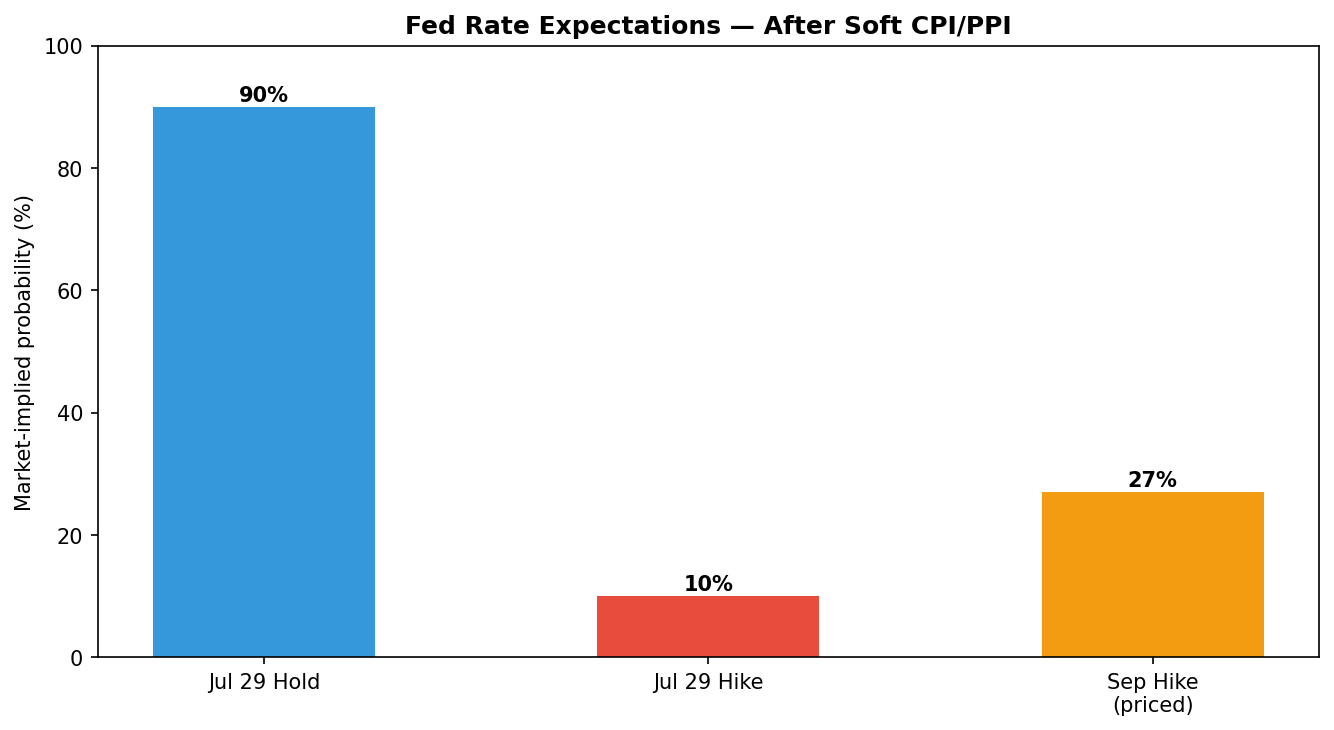
Fed rate expectations — after soft CPI/PPI. Source: CME FedWatch Tool
CME FedWatch Tool. Source: https://www.cmegroup.com/markets/interest-rates/cme-fedwatch-tool.html
News in focus — remainder of the week
Thursday, July 16: TSMC earnings (delivered — record beat); Netflix Q2 earnings (after market close) — subscriber growth and ad revenue in focus at 32x forward P/E; June Retail Sales and Initial Jobless Claims — consumer spending pulse after the weak June jobs report (+57K payrolls).
Friday, July 17: American Express earnings; Michigan Consumer Sentiment (final, July) — late-month confidence read.
Monday, July 14 (recap): Big-bank earnings — JPM, GS, BAC, C, WFC all beat estimates.
Ongoing: Warsh congressional testimony — any explicit signal on July 29 would move markets instantly.
Ongoing: AI earnings dispersion — software vs hardware vs platforms; IBM miss sets the cautionary template.
Ongoing: Middle East oil bid — Hormuz shipping and US–Iran diplomatic channel remain the key tail-risk.
Now let's shift to potential scenarios and trading ideas for the remainder of the week, covering the post-CPI landscape, the AI rotation and the key levels to watch.
NAS100 (Nasdaq)
The Nasdaq has benefited from the CPI/PPI disinflation trade and megacap tech strength — Apple at all-time highs, Alphabet and Microsoft rallying — but faces growing headwinds from semiconductor profit-taking and TSMC's "sell the news" reaction.
A constructive scenario assumes Netflix earnings beat on Thursday and retail sales confirm resilient consumer spending. In that case, the index may hold the 26,200–26,400 zone and attempt a push toward the prior peak. Software and platform names may continue to outperform hardware.
The risk scenario — which Thursday's price action supports — involves continued rotation out of chipmakers, a soft Netflix subscriber print, and renewed Middle East friction pushing oil higher. In that case, the index may retest 25,800–26,000, particularly if the equal-weight vs cap-weight divergence widens further.
Nasdaq Composite, daily chart. Source: Exness.com
XAUUSD
Gold has been whipsawed this week. It rebounded on Tuesday's soft CPI as inflation fears receded and the dollar softened, but remains sensitive to the competing forces of lower rate-hike odds (supportive) and Middle East oil bid (mixed — higher oil can lift inflation expectations and pressure gold through the dollar channel).
A possible scenario involves gold stabilising in the $4,100–4,150 zone if the Fed hold narrative holds and geopolitical tensions do not escalate further. Bank of America's 14% forecast cut to $4,360 for 2026 average gold provides a medium-term anchor. A break above $4,175 would require a dovish shift in Warsh's rhetoric or a sharp oil reversal.
XAUUSD, H4 chart. Source: Exness.com
USOIL
Oil retains a bid despite the soft CPI/PPI, reflecting the market's assessment that the US–Iran conflict is not resolved. Brent has held above $75–78 even as inflation data cooled — a divergence that will matter for the July CPI print if energy costs re-accelerate.
A possible scenario involves oil grinding toward $80–82 if Middle East headlines worsen before the July 29 Fed meeting. The invalidation zone sits near $72–74, where the pre-escalation consolidation had formed. Soft retail sales or a diplomatic breakthrough could trigger a move back toward that area.
USOIL, daily chart. Source: Exness.com
Disclaimer: This material is for informational and analytical purposes only. It does not constitute investment advice, a recommendation, or a solicitation to trade. Financial markets involve substantial risk of loss. Past price behaviour and scenario analysis do not guarantee future results. All trading decisions remain the sole responsibility of the reader.