5 June 2026
A hot NFP paints markets red — gold, Nasdaq and crypto tumble
The first week of June in the financial markets was dominated by a single macro trigger: the US May nonfarm payrolls report, released on Friday, June 5. What looked like a routine end-of-week data print turned into the sharpest cross-asset selloff in more than a year. The Nasdaq Composite shed over 4%, the S&P 500 snapped a nine-week winning streak, gold slid from session highs near $4,514, and Bitcoin briefly tested the $60,000 area.
The narrative that had carried risk assets through spring — a softening labour market opening the door to Fed easing — was effectively reversed in one morning. Instead of pricing in rate relief, traders began to reprice the path toward a more hawkish Federal Reserve, with CME FedWatch odds of at least one rate hike in 2026 climbing above 55% shortly after the release.
The NFP surprise: 172K vs ~85K expected
According to the US Bureau of Labor Statistics, total nonfarm payroll employment increased by 172,000 in May, while the unemployment rate held steady at 4.3%. Economists had generally expected a gain of roughly 80,000–85,000 jobs — meaning the actual print more than doubled consensus.
The report also carried meaningful upward revisions. March payrolls were revised up by 29,000 to +214,000, and April was revised up by 64,000 to +179,000. Combined, March and April employment is now 93,000 higher than previously reported, reinforcing the picture of a labour market that is not cooling as quickly as markets had hoped.
Sector composition was mixed but constructive for the headline number. Leisure and hospitality added 70,000 jobs, local government rose by 55,000, and health care added 35,000. Financial activities declined by 22,000, continuing a downtrend from the sector's peak in May 2025. Average hourly earnings rose 0.3% month-on-month and 3.4% year-on-year, in line with expectations — enough to confirm wage growth without adding a fresh inflation scare on the day.
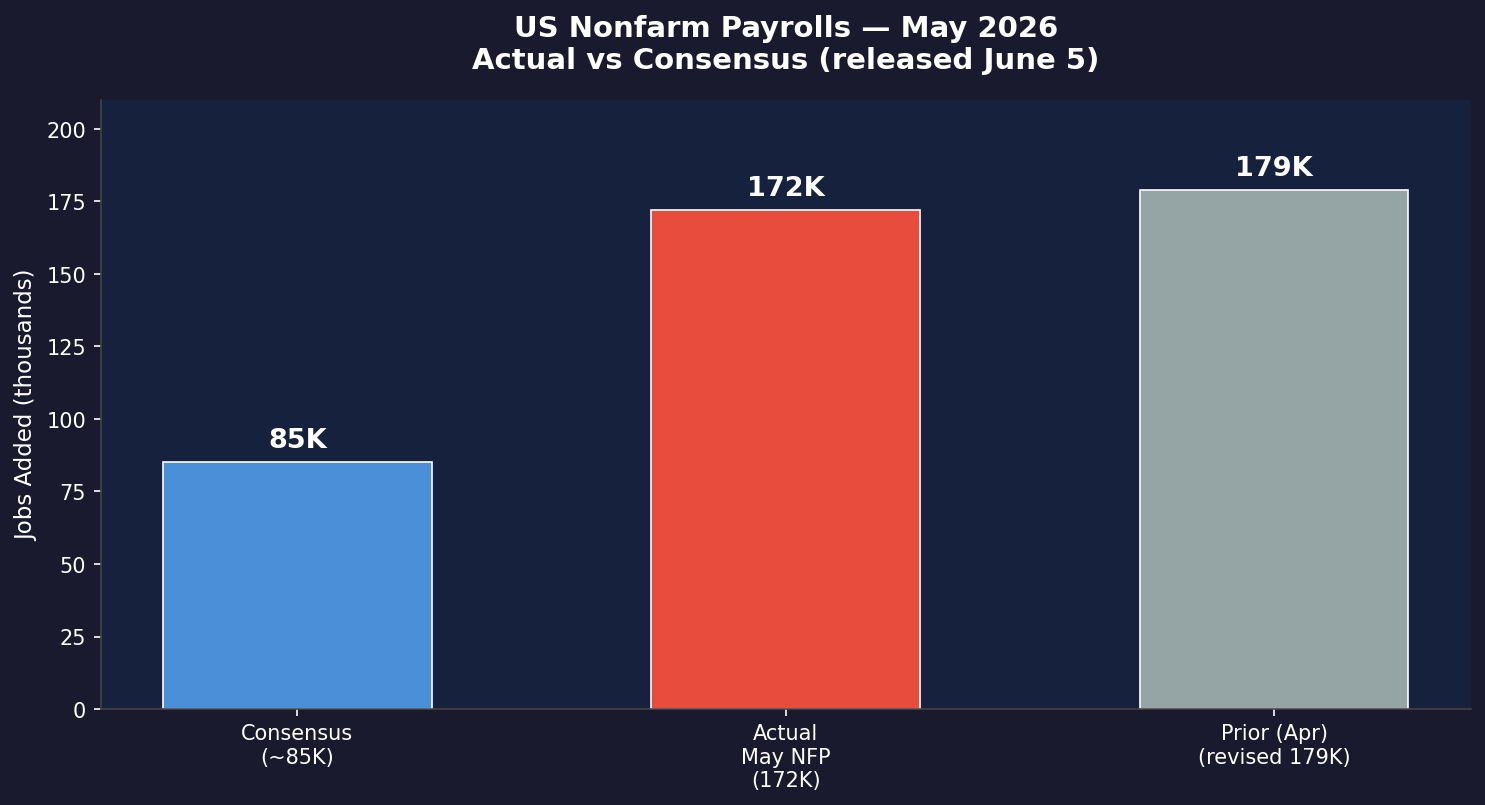
US Nonfarm Payrolls — May 2026. Actual vs consensus. Source: US Bureau of Labor Statistics
For markets, the takeaway was straightforward: the US economy is still creating jobs at a pace that reduces urgency for near-term rate cuts. The "good news is bad news" dynamic returned in full force — strong employment data lifted the US dollar and bond yields, while pressuring duration-sensitive equities and non-yielding assets.
Friday's red day: Nasdaq, gold and crypto in sync
The reaction was broad and fast. Treasury yields jumped — the 10-year yield moved above 4.5%, its highest level in a year, while the 2-year yield climbed toward the 4.16% area. The US Dollar Index rallied sharply, draining liquidity from assets that do not offer a coupon or dividend.
The Nasdaq Composite recorded its worst single-day decline in more than a year, falling roughly 4.0–4.2%. Growth and AI-linked names, which had led the nine-week rally in the S&P 500, bore the brunt of the move as higher-for-longer rate expectations compressed valuation multiples.
Gold (XAU/USD) also declined, despite its traditional role as a geopolitical hedge. The metal dropped from intraday highs near $4,514 toward the $4,300 area, underscoring that this was a dollar-and-yields-driven repricing rather than a simple flight from equities into safe havens. When real yields rise and the dollar strengthens, gold tends to struggle even during equity selloffs.
Bitcoin followed the same macro script. BTC/USD fell from above $63,000 toward the $61,900 range, with some venues printing brief wicks below $60,000 before a modest bounce into the close. Crypto's sensitivity to Fed expectations has increased as institutional participation has grown — the asset now trades more like a high-beta risk instrument than an isolated alternative store of value.
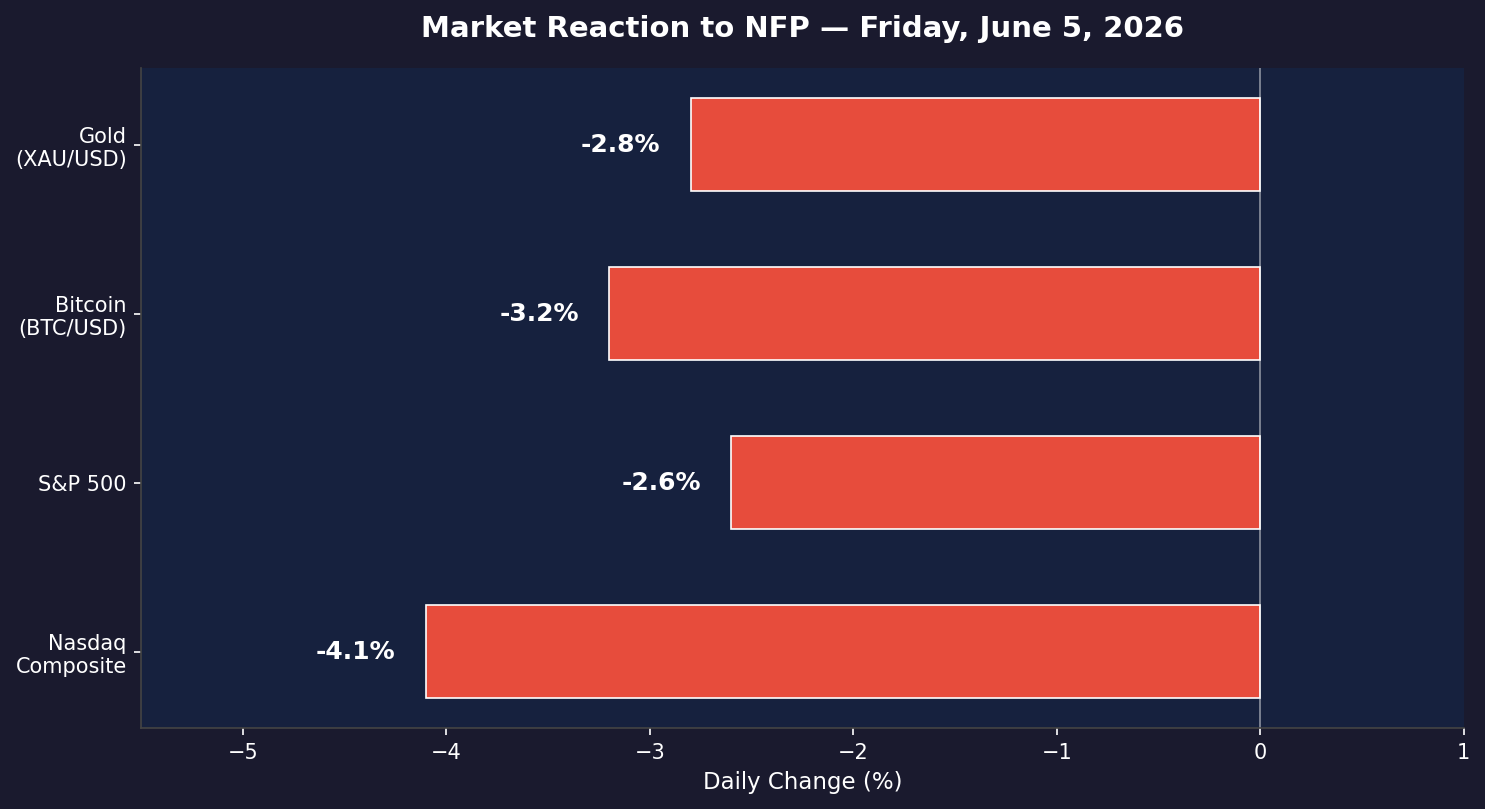
Market reaction to NFP — Friday, June 5, 2026. Source: market data
The VIX, which had been sitting in a relatively subdued range through late May, spiked on Friday as equity implied volatility reset higher. The CNN Fear & Greed Index, which had been hovering in neutral-to-greedy territory, shifted back toward fear — a sign that the short-term risk appetite built over the prior nine weeks has been at least partially unwound.
Fed repricing: from cuts to hikes
The most consequential shift was in rate expectations. Before the report, CME FedWatch assigned a 96.4% probability to the Fed holding rates unchanged at the June 17 meeting. That near-certainty on June policy did not change dramatically — the June decision was never expected to deliver a move. What changed was the back half of 2026.
Within minutes of the NFP release, the implied probability of at least one rate hike before year-end climbed from roughly 50% to above 57%, overtaking the combined odds of a hold-or-cut path. Some pricing now reflects a minority chance of a December 2026 hike — the first non-zero hike odds on FedWatch since 2023. The earliest rate cut carrying majority market odds has been pushed out toward September, at the earliest.
CME FedWatch Tool — rate expectations. Source: https://www.cmegroup.com/markets/interest-rates/cme-fedwatch-tool.html
The policy backdrop adds another layer. The June 16–17 FOMC meeting will be Kevin Warsh's first as Fed chair, with the dot plot and statement language likely to attract outsized attention. Markets are not pricing an immediate hike at that meeting, but the NFP data strengthens the case for hawkish patience in the statement — a direct tension with political pressure for easier policy.
US 10-year Treasury yield. Source: https://www.tradingview.com/symbols/TVC-US10Y/
News in focus this week
Monday, June 8: China trade balance — early read on external demand and commodity flows.
Tuesday, June 9: China PPI (May) — input-cost signal for global manufacturing and inflation pipelines.
Wednesday, June 10: US CPI (May) — the critical follow-up to NFP. Consensus expects headline CPI around +0.5% MoM, lifting the annual rate toward 4.2%. A hotter print would reinforce the hawkish repricing; a miss could allow a partial recovery in risk assets.
Wednesday, June 10: Bank of Canada rate decision — cross-read for G10 central bank divergence.
Thursday, June 11: US PPI (May) — secondary inflation gauge; Euro area ECB rate decision.
Friday, June 12: UK GDP (monthly) — sterling and European sentiment.
Tuesday–Wednesday, June 16–17: FOMC meeting, statement, dot plot and press conference — the dominant event risk for the month.
Now let's shift to potential scenarios and trading ideas for the week ahead, covering the post-NFP repricing and the possible short-term swings that may develop around the CPI release and the FOMC meeting.
XAUUSD
Gold is in an interesting position after Friday's flush. The metal had been trading near multi-week highs before the NFP release, supported by geopolitical hedging demand and a generally constructive trend. The data-driven spike in the US dollar and yields triggered a sharp intraday reversal, with XAU/USD sliding from the $4,514 area toward $4,300.
From a swing perspective, the short-term structure now favours a bearish continuation rather than an immediate recovery. The break below the post-rally consolidation zone suggests that the repricing of Fed expectations may keep pressure on non-yielding assets through the early part of the week — particularly if Wednesday's CPI print confirms sticky inflation.
A possible scenario involves a short-term swing short on gold, targeting a move toward the $4,200–$4,250 area as the market digests higher yields and a stronger dollar. The invalidation level for this scenario would sit above the $4,450–$4,480 zone, where the pre-NFP highs and the 20-day moving average converge. A softer-than-expected CPI on Wednesday would likely challenge this setup and could trigger a rapid short-covering rally.
Given elevated event risk around CPI and the FOMC, position sizing and stop placement warrant particular attention this week.
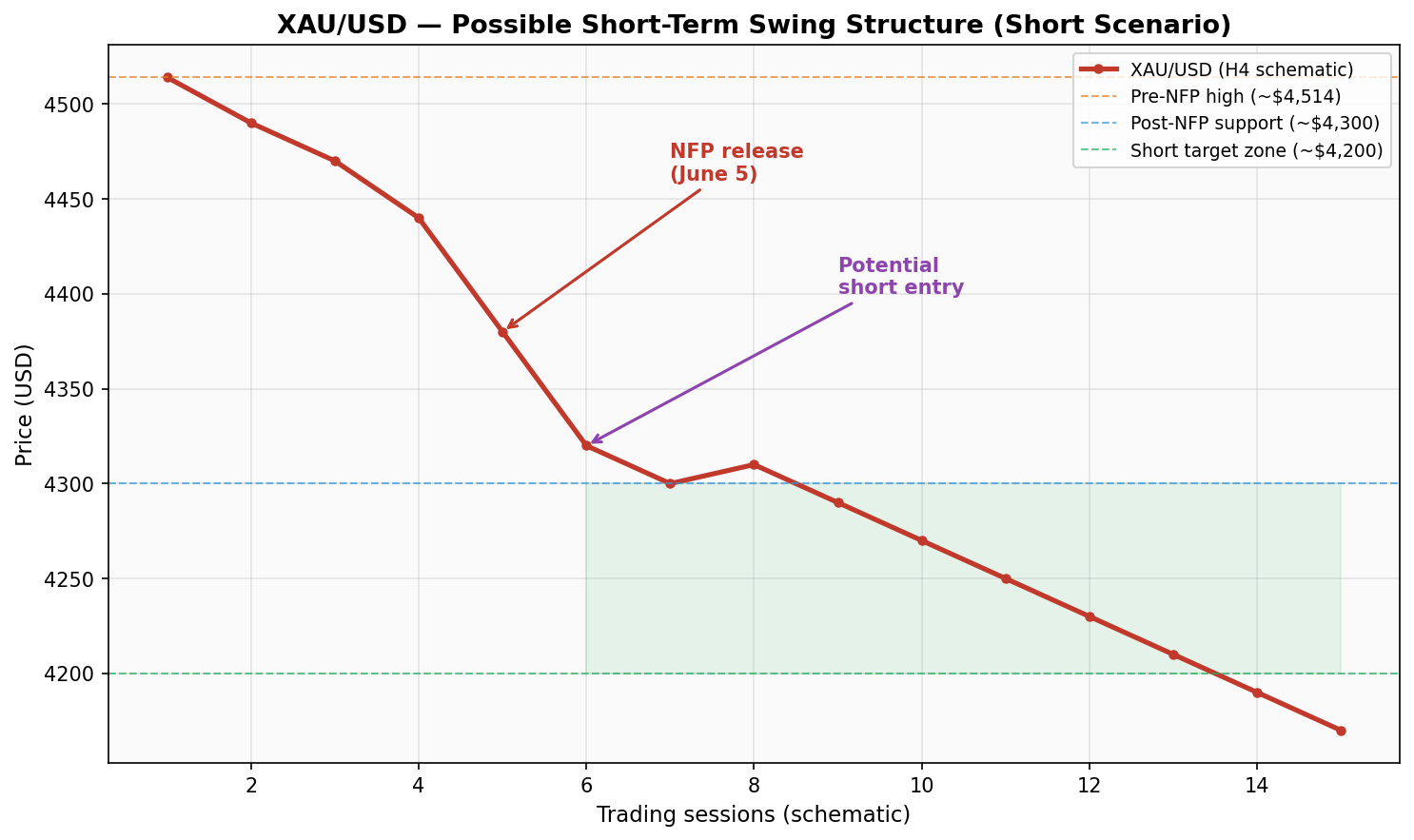
XAU/USD, H4. Possible development of the swing structure. Source: Exness.com
NAS100 (Nasdaq)
The Nasdaq recorded the most visible damage on Friday, but sharp selloffs on strong macro data sometimes create short-term mean-reversion opportunities — especially when the underlying earnings and AI narrative remain intact.
The index had been the leader of the nine-week equity rally, and Friday's 4%+ drop may represent an overreaction relative to the actual change in the 2026 earnings outlook. Historically, the first trading sessions after a macro shock of this magnitude have seen two-way flows: residual selling from systematic funds on Monday, followed by dip-buying from longer-horizon investors once the initial repricing settles.
A possible scenario for the week ahead is a pullback buy on Tuesday–Wednesday, assuming Monday does not bring a follow-through CPI surprise. The 20,800–21,000 area on the Nasdaq Composite may act as an initial support zone where responsive buying could emerge. Confirmation would require stabilisation in bond yields and a pause in the dollar rally — conditions that a benign CPI print on Wednesday could provide.
The risk to this scenario is a hotter CPI reading that pushes Fed hike odds above 60% and triggers a second leg lower in tech. In that case, the index may retest the 20,500 area before any durable base forms. The FOMC meeting on June 16–17 remains the larger catalyst; the Tue–Wed window is best framed as a short-term swing rather than a structural trend reversal.
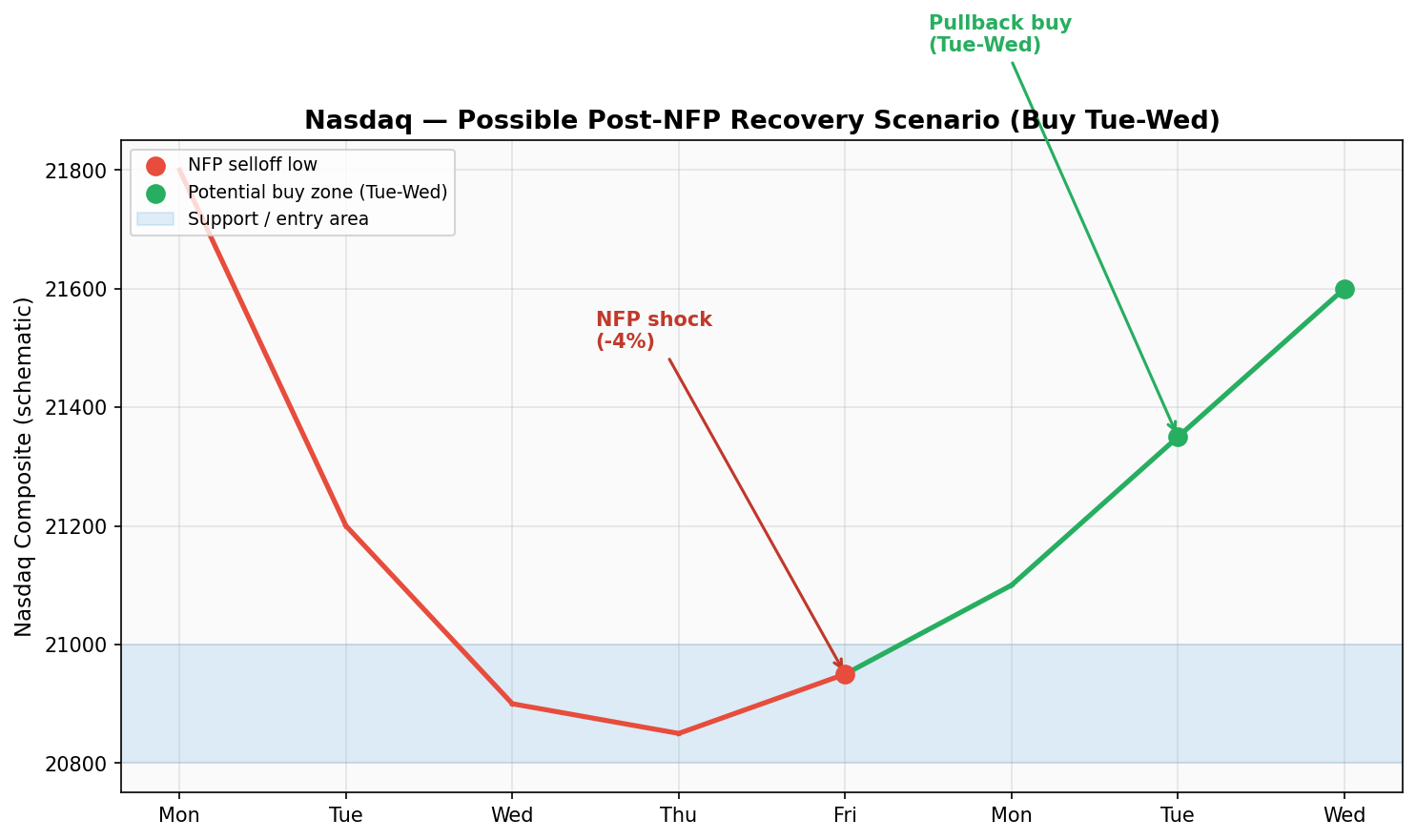
Nasdaq Composite, daily. Possible development of the swing structure. Source: Exness.com
Disclaimer: This material is for informational and analytical purposes only. It does not constitute investment advice, a recommendation, or a solicitation to trade. Financial markets involve substantial risk of loss. Past price behaviour and scenario analysis do not guarantee future results. All trading decisions remain the sole responsibility of the reader.