30 July 2026
Bond rout sends a warning to Warsh — tough talk is not enough
The Federal Reserve's July 29 FOMC meeting was supposed to clarify the path of US monetary policy under Kevin Warsh's reform agenda. Instead, it produced the most volatile post-meeting session in years — and a message from the bond market that Bloomberg summarised bluntly: for all of Warsh's tough talk about taming inflation, he is in no rush to use the central bank's power to do it.
The Fed held rates unchanged at 3.50–3.75% for a seventh consecutive meeting — widely expected. What was not expected was the scale of the market's rebuke. Investors dumped 30-year Treasury bonds, sending the yield up as much as 14 basis points to nearly 5.23% — a 19-year high, last seen in July 2007. The Dow fell more than 1,150 points (-2.19%), its worst day since April 2025. The Nasdaq dropped -1.74% to a three-month low. Even gold, which initially rallied on the hold, gave back gains as rising real yields reasserted dominance.
The post-Fed landscape is now defined by a single tension: Warsh believes markets have already tightened for the Fed by pushing yields higher — and that ending forward guidance is working. Bondholders, equity investors and three dissenting FOMC members disagree.
The decision: hold, but the committee is divided
The FOMC voted 9–3 to leave the federal funds rate unchanged. Three regional Fed presidents — Beth Hammack (Cleveland), Neel Kashkari (Minneapolis) and Lorie Logan (Dallas) — dissented in favour of an immediate 25bp hike. It was the largest dissent bloc since September 2016 and the first split vote of the Warsh era.
Warsh described the meeting as "a good family fight" — but markets read the division differently. CNBC's Jon Hilsenrath wrote that "Warsh didn't convey the message clearly or explicitly, and the bond market puked on him." JPMorgan analysts pulled forward their rate-hike call from H2 2027 to December 2026.
The policy statement itself changed little. Inflation remained "somewhat elevated", the labour market "solid", and the Middle East conflict continued to feed energy-price uncertainty. The statement ended with a stripped-down commitment: the Committee "will deliver price stability."
No dot plot was released. No forward guidance was offered. Warsh has deliberately abandoned both — arguing that past Fed chairs made the institution inflexible by telegraphing future moves, and that markets should "play the ball, not the referee."
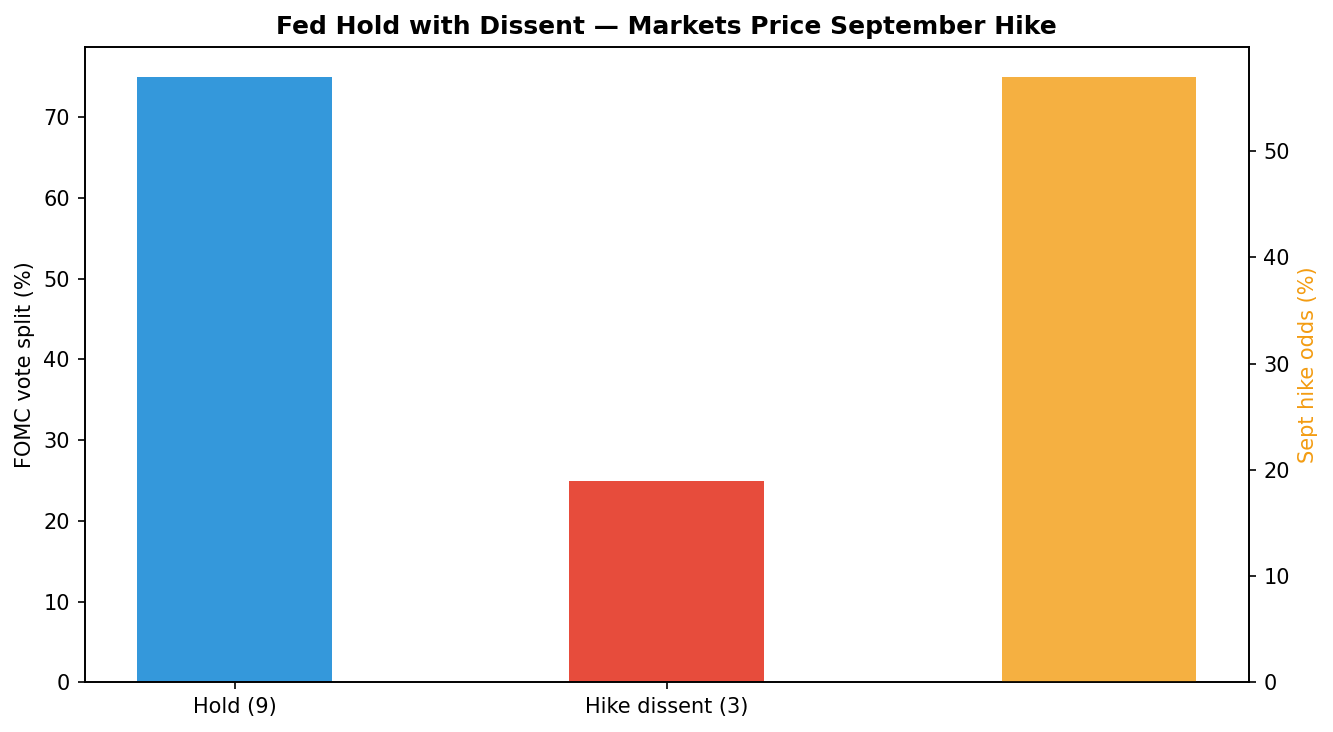
FOMC vote split and September hike pricing — July 29, 2026. Source: CME FedWatch
The bond rout: markets call Warsh's bluff
The defining market event was not the hold itself — it was what happened to the yield curve during and after Warsh's press conference.
| Tenor | Move | Level |
|---|---|---|
| 2-year | Fell ~4bp | ~4.24% |
| 10-year | Rose ~9bp | ~4.86% |
| 30-year | Rose ~12–14bp | ~5.23% |
This produced one of the sharpest bear-steepenings after a Fed meeting since the mid-1990s. The interpretation was unambiguous:
- Short end: Markets scaled back immediate hike bets — the July hold was confirmed, and near-term policy would stay put.
- Long end: Bondholders demanded higher compensation for inflation risk stretching years ahead — a vote of no confidence in Warsh's inflation-fighting credibility.
Warsh's own explanation fuelled the selloff. He argued repeatedly that "markets have done quite a bit" in the 42 days since the June meeting, that Treasury yields had risen as participants reacted to real data rather than Fed guidance, and that this tightening "has provided us some comfort that we've got the ability and capability to deliver."
DoubleLine's Jeffrey Gundlach put the market's response in plain terms: "The bond market vigilantes are saying, 'If you really want us to believe your rhetoric, you've got to start acting.'" Chris Rupkey of Fwdbonds was blunter: "The Warsh Fed seems to be turning a blind eye to the message the bond market's higher yields are sending about inflation risks."
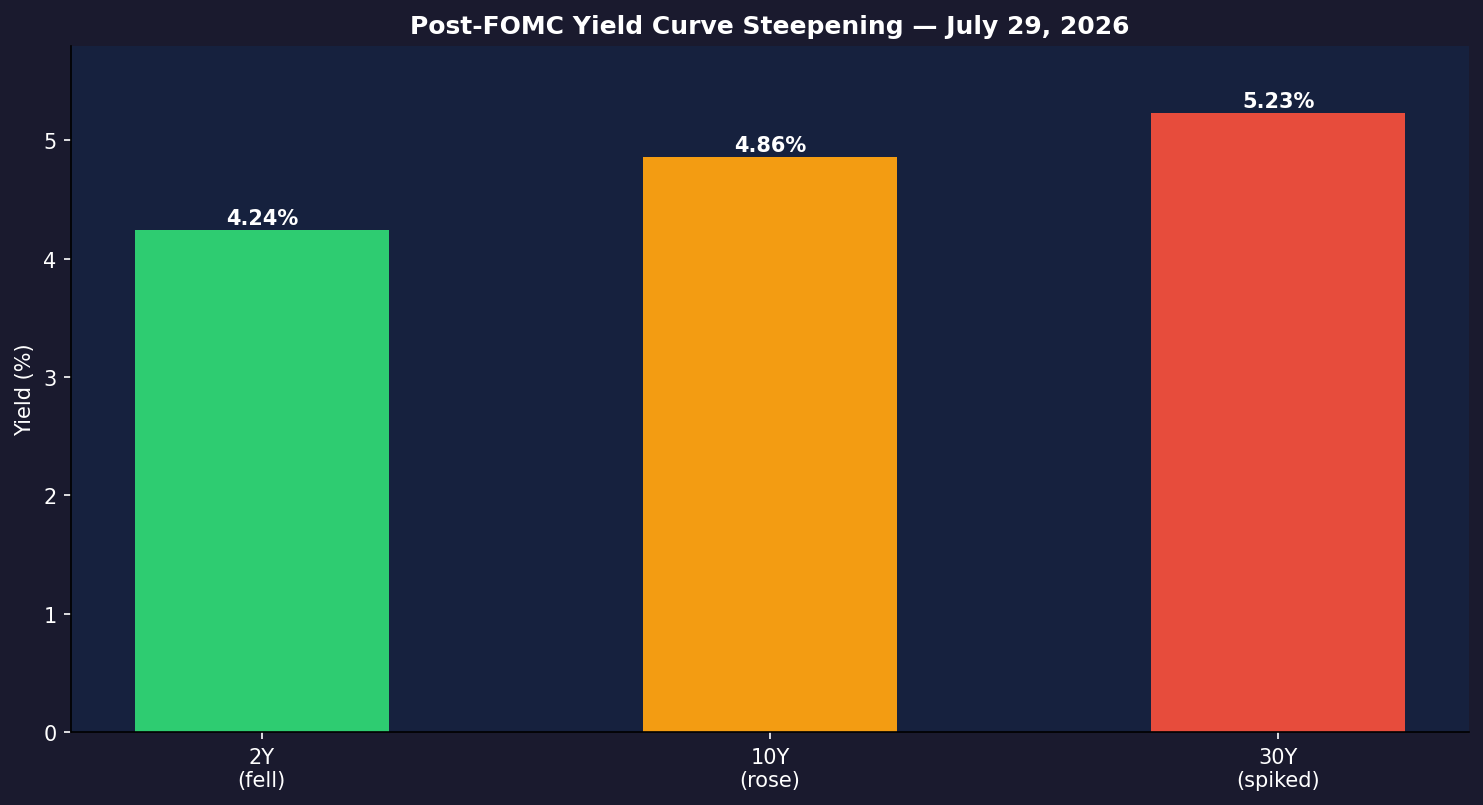
Post-FOMC yield curve steepening — July 29, 2026. Source: Bloomberg / US Treasury
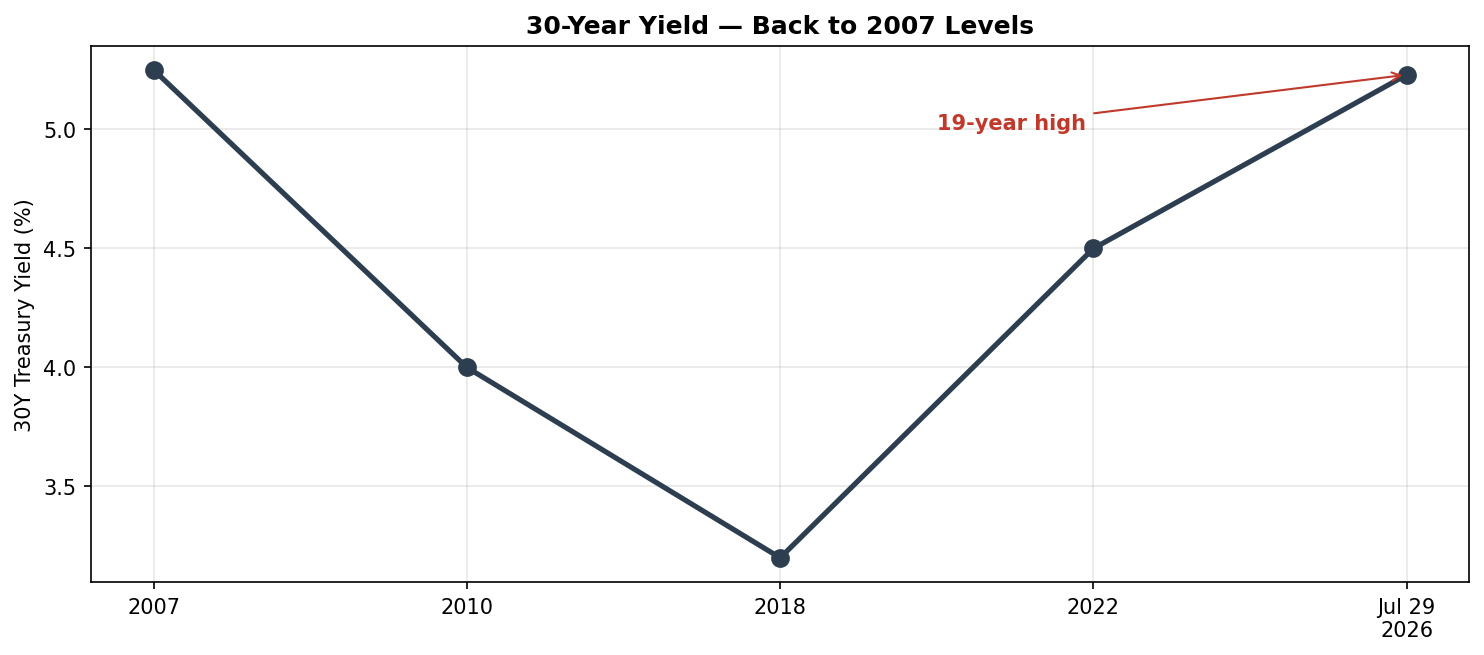
30-year Treasury yield — highest since July 2007. Source: Bloomberg
US Treasury yield curve. Source: https://www.ustreasuryyieldcurve.com/
Equities: the 65-minute reversal
US stocks whipsawed through the Fed day before collapsing during Warsh's press conference. As Wolf Street noted, between 2:55 p.m. (midway through the Q&A) and the close, the S&P 500 fell 138 points (-1.85%) — a reversal from green to deep red in 65 minutes.
Final closes on Wednesday, July 29:
| Index | Change | Level |
|---|---|---|
| Dow Jones | -2.19% (-1,153 pts) | 51,594 |
| S&P 500 | -1.52% | 7,316 |
| Nasdaq Composite | -1.74% | 24,443 |
It was the worst "Fed day" for a new chair in recent history, according to Bespoke Investment Group. The Nasdaq entered correction territory from its late-May peak, with the Magnificent Seven index down more than 11%.
The VIX surged +13.29% on the session. Growth and AI-linked names faced the heaviest pressure as higher discount rates compressed valuation multiples — the same mechanism that had punished megacap tech throughout July.
Earnings provided no cushion. Microsoft had rallied +8% on strong cloud growth and disciplined capex messaging, but Meta fell on rising expenses and weak guidance. The post-Fed selloff overwhelmed stock-specific positives.
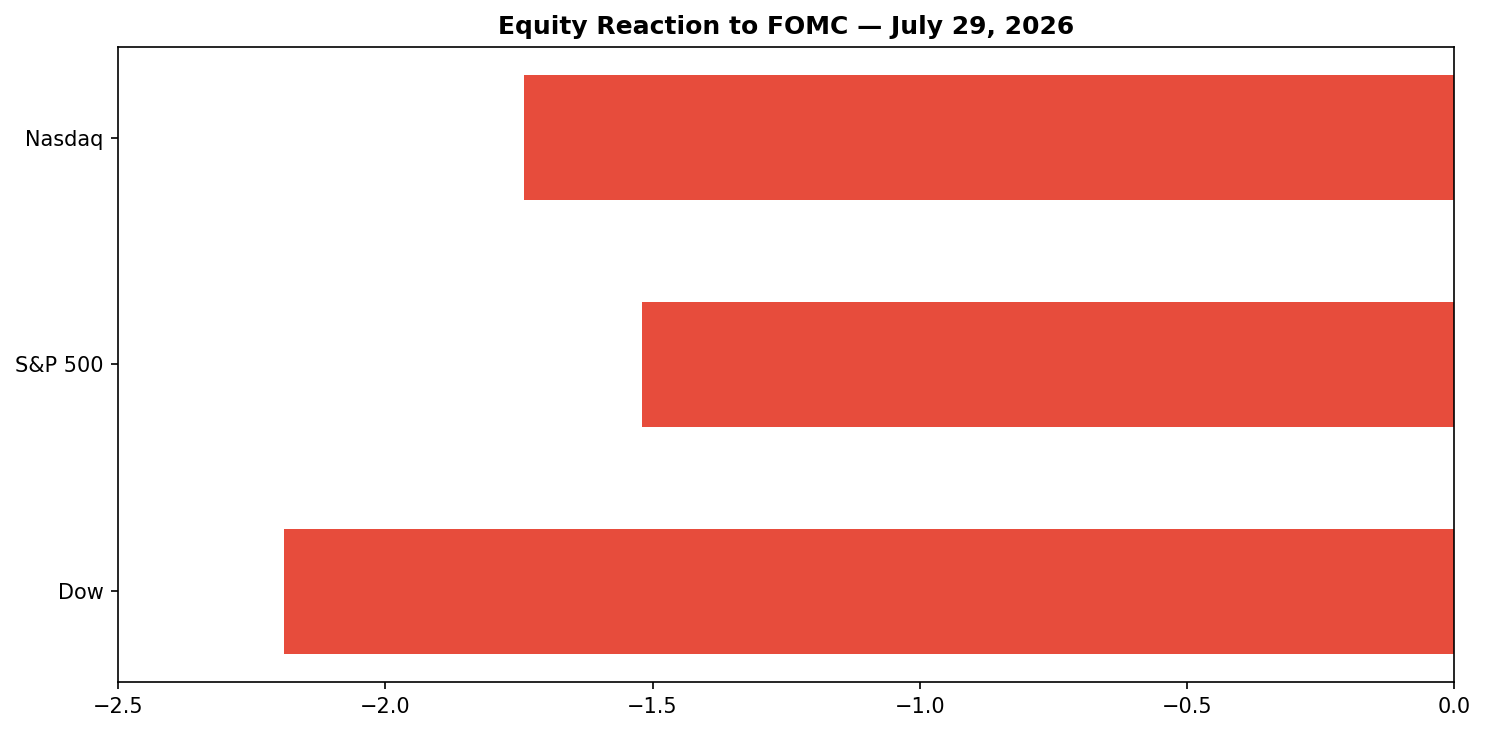
Equity reaction to FOMC — July 29, 2026. Source: Bloomberg / CNBC
Gold, oil and the dollar: a three-way tug of war
Cross-asset moves after the Fed reflected the competing forces at play:
Gold (XAU/USD): Initially rallied ~2% toward $4,102 on relief that the Fed did not hike — the classic "hold is dovish" reaction. But as long-end yields surged and the dollar recovered, gold settled back near $4,080. The metal remains trapped between safe-haven demand from Middle East tensions and the headwind of rising real yields. September hike odds at ~57% (down from 80%+ pre-meeting, but still elevated) keep the macro channel active.
Oil: Brent surged back toward $90 (+8% on the session) as President Trump renewed warnings to "hit Iran hard" and US strikes on Iran continued. The Fed statement explicitly cited the Middle East conflict as an inflation risk. With Brent at $90 and the 30-year yield at 5.23%, the Fed faces a stagflationary policy bind that a hold does not resolve.
US dollar: The DXY surged during the press conference before closing -0.62% — a whipsaw that reflected the competing read of "no hike" (dovish) versus "bond vigilantes forcing future tightening" (hawkish).
What markets are pricing for September
The post-Fed repricing shifted the timeline but did not remove the tightening path:
- September hike probability: ~57% (CME FedWatch) — down from 80%+ earlier in the week, but sharply higher than the pre-July-meeting baseline.
- December 2026 hike: JPMorgan pulled its call forward to this date.
- Kalshi: ~53% of traders predict a hike at the next meeting vs 43% for another hold.
Warsh offered no clues on September during the press conference. When asked about his upcoming Jackson Hole speech in August, he described it as "a blank piece of paper right now" — offering little reassurance to markets craving clarity.
The September 15–16 meeting will arrive with August CPI and jobs data in hand. If long-end yields remain above 5.20% and oil holds near $90, the pressure on Warsh to act — or to provide a credible framework for why the bond market should do the work for him — will intensify.
CME FedWatch Tool. Source: https://www.cmegroup.com/markets/interest-rates/cme-fedwatch-tool.html
News in focus — post-Fed week
Thursday–Friday, July 30–31: Markets digest the bond rout; month-end flows and rebalancing may amplify yield moves. Q2 GDP (advance) and Core PCE due this week.
Early August: Jackson Hole symposium (Aug 21–23) — Warsh's first major policy speech as chair; markets expect a clarification of the "no forward guidance" framework or a further credibility test.
September 15–16: Next FOMC meeting — currently priced as a live hike decision.
Ongoing: US–Iran conflict — Brent at $90 reintroduces energy inflation into the Fed's reaction function.
Ongoing: Q2 earnings tail — Amazon, Apple and remaining megacaps report; capex vs cash-flow scrutiny continues.
Now let's shift to potential scenarios and trading ideas in the post-Fed environment, covering the bond-equity divergence and the key levels to watch.
US10Y / bond complex
The post-Fed bear-steepening has pushed the 30-year yield to 5.23% and the 10-year toward 4.86% — levels that effectively tighten financial conditions without the Fed moving the policy rate. MUFG Research noted that August is typically a positive seasonal period for bonds, and the backup may present a window to buy the long end — but only if inflation data softens.
A possible scenario involves 30-year yields stabilising near 5.15–5.25% if Warsh uses Jackson Hole to clarify his framework. A break above 5.30% would signal the bond vigilantes are forcing the issue, with implications for mortgage rates, corporate borrowing and equity multiples.
US 10-year Treasury yield, daily chart. Source: Exness.com
NAS100 (Nasdaq)
The Nasdaq at 24,443 sits at a three-month low, pressured by the dual headwind of rising discount rates and ongoing AI capex scrutiny. The post-Fed selloff confirmed that even strong individual earnings (Microsoft) cannot offset a macro-driven de-rating when the 30-year yield hits 2007 levels.
A constructive scenario requires long-end yields stabilising below 5.15% and September hike odds fading below 50%. Support may emerge near 24,000–24,200. The risk scenario — more probable near-term — involves yields grinding higher and oil holding above $88, pushing the index toward 23,500–23,800.
Nasdaq Composite, daily chart. Source: Exness.com
USOIL
Brent's surge back toward $90 (+8% on the Fed day) reintroduced energy inflation into the post-meeting narrative just as Warsh argued markets had already tightened for him. The Fed statement explicitly flagged Middle East disruption as an inflation risk — and with the 30-year yield at 5.23%, the central bank faces a stagflationary bind that a hold does not resolve.
A possible scenario involves oil holding $88–92 as geopolitical premium persists and the Fed's September decision remains live. A de-escalation in the US–Iran conflict could pull Brent toward $82–85, easing one inflation channel. The risk scenario — more aligned with the current backdrop — involves renewed escalation pushing Brent back toward $95–100, reinforcing bond vigilantes' demand for higher long-end yields and keeping September hike odds elevated.
USOIL, daily chart. Source: Exness.com
XAUUSD
Gold's initial post-Fed rally faded as rising real yields reasserted dominance. The metal near $4,080 sits at a crossroads: safe-haven demand from the Iran conflict provides a floor, while the 30-year yield at 5.23% caps the upside.
A possible scenario involves gold holding $4,050–4,100 as markets digest the Fed hold and position for Jackson Hole. A hawkish clarification from Warsh in August — or a September hike confirmation — could push gold toward $3,950–4,000. Recovery above $4,175 requires long-end yields to reverse meaningfully.
XAUUSD, H4 chart. Source: Exness.com
Disclaimer: This material is for informational and analytical purposes only. It does not constitute investment advice, a recommendation, or a solicitation to trade. Financial markets involve substantial risk of loss. Past price behaviour and scenario analysis do not guarantee future results. All trading decisions remain the sole responsibility of the reader.