20 June 2026
SpaceX makes history as markets balance IPO euphoria, Iran talks and the Fed
The current week in the financial markets is developing under a layered narrative that mixes record-breaking equity issuance, lingering geopolitical uncertainty and the most closely watched Federal Reserve decision of the year so far. After a volatile macro stretch earlier in June, sentiment has partially recovered — but the market's attention has shifted from backward-looking data toward forward-looking catalysts: the SpaceX debut, renewed signals of a possible peaceful agreement between the US and Iran, and the FOMC meeting on Wednesday.
Despite the conflict in the Middle East having stretched into a fourth month, major US stock indices have continued to trade near elevated levels, supported primarily by AI-linked names and a broader appetite for growth. The SpaceX IPO has added a fresh wave of risk-on energy to the Nasdaq, even as bond yields remain sticky and traders prepare for Kevin Warsh's first policy decision as Fed chair.
SpaceX: the largest IPO in history
The dominant market event of the past week was the public debut of Space Exploration Technologies Corp. (SPCX). The company priced its offering at $135 per share, raising approximately $75 billion — the largest initial public offering in US stock-market history — at a fully diluted valuation near $1.77 trillion.
Shares began trading on the Nasdaq on Friday, June 12, opening at $150 and closing at $160.95, a +19.2% gain from the IPO price. At its intraday peak, the stock briefly pushed the company's market value above $2.25 trillion, before settling around the $2.1 trillion area by the close. Goldman Sachs, Morgan Stanley, BofA Securities, Citigroup and JPMorgan served as joint book-running managers.
Two features of the deal stand out for market structure. First, retail participation was unusually high: roughly 20–30% of the offering was allocated to everyday investors through brokerages such as Fidelity, Schwab and SoFi — well above the typical 5–10% retail slice for mega-cap IPOs. Second, SpaceX may be fast-tracked for inclusion in major indices such as the Nasdaq-100, with the exchange now allowing newly listed companies to qualify after as few as 15 trading days if their market cap ranks among the largest constituents. That creates a potential pipeline of passive-fund buying in the weeks ahead.
The IPO has been widely interpreted as a referendum on the AI-and-innovation trade. SpaceX spans rocket launches, Starlink satellite broadband and adjacent technology initiatives, placing it at the intersection of defence, communications and the broader tech rally. Goldman Sachs President John Waldron described the offering as evidence that capital markets remain willing to fund large-scale innovation bets — even in an environment of elevated rates and geopolitical risk.
Some scepticism remains. Morningstar and other analysts have questioned the valuation relative to reported revenue and recent operating losses, noting that the price implies aggressive long-term growth assumptions. For the week ahead, the key question is whether SPCX can sustain its first-day momentum or whether the stock begins to trade more like a post-IPO digestion pattern, with volatility compressing after the initial euphoria fades.
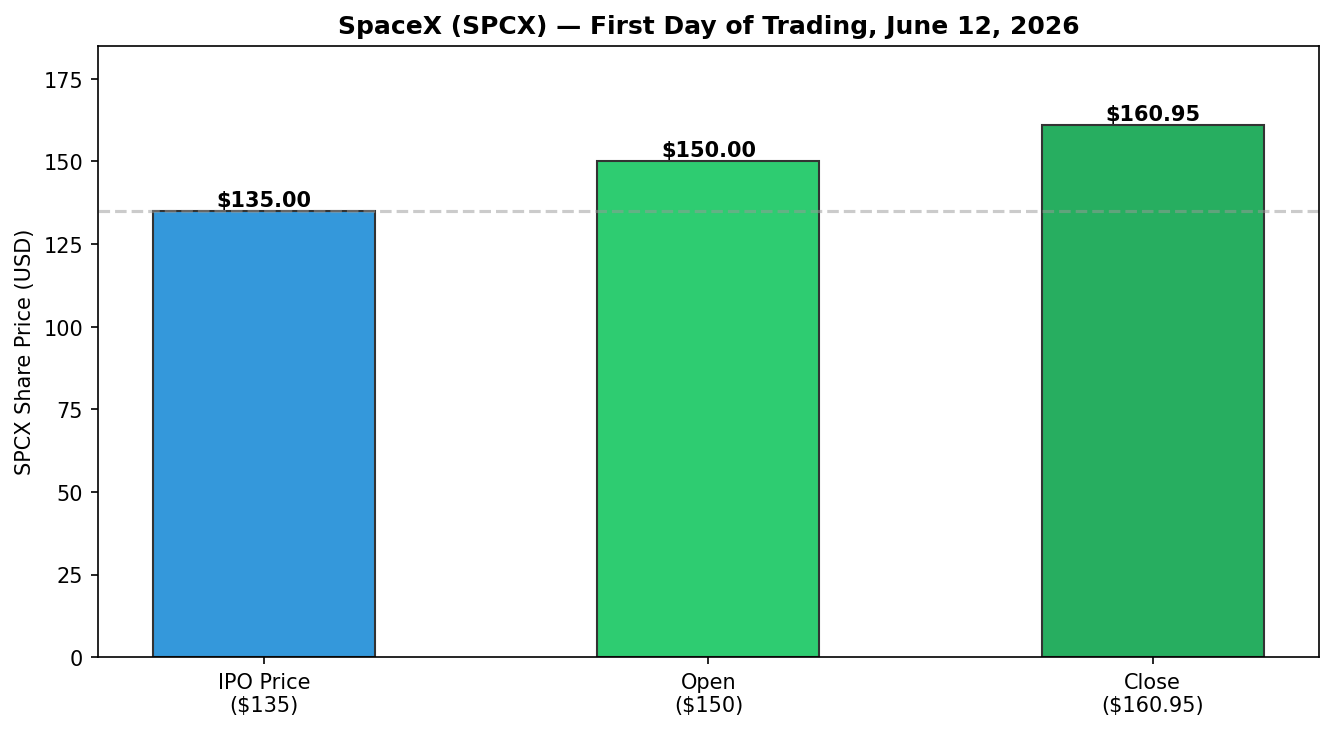
SpaceX (SPCX) — first day of trading, June 12, 2026. Source: Nasdaq / market data
US–Iran: peace talks back on the radar
Alongside the IPO headlines, diplomatic signals around a possible peaceful agreement between the US and Iran have re-emerged as a market driver. Earlier in the year, rumours of a ceasefire and a broader de-escalation framework had supported the "relief rally" narrative — pushing Brent crude lower, easing geopolitical risk premiums in bonds and lifting market breadth beyond pure AI leaders.
That progress has been uneven. Negotiations have repeatedly stalled over the status of the Hormuz Strait, nuclear-program conditions and regional security guarantees. War-risk insurance premiums remain elevated relative to normal periods, and energy markets continue to price a non-trivial chance of renewed disruption. Still, the tone from recent weekend talks has been constructive enough for traders to begin repricing the tail-risk scenario lower.
For markets, a credible path toward a peaceful agreement would likely trigger a familiar chain reaction:
- Crude oil would face downward pressure as the geopolitical risk premium erodes, with Brent potentially drifting back toward the $85–90 area in a constructive scenario.
- Bond yields at the long end could ease modestly if energy-driven inflation fears fade.
- Risk appetite would improve, supporting cyclical sectors, airlines, transport and industrial names that had lagged during the escalation phase.
- The US dollar could soften modestly in a "risk-on / peace premium unwind" move, though the effect may be limited if the Fed remains hawkish.
Conversely, should talks collapse or military rhetoric intensify again, oil volatility would likely return quickly — and the equity rally, including the post-IPO enthusiasm around SPCX, could face a sharper test. Historically, crude oil has been trading with extreme realised volatility during this conflict, and the market typically needs a period of stabilisation before committing to the next directional wave.
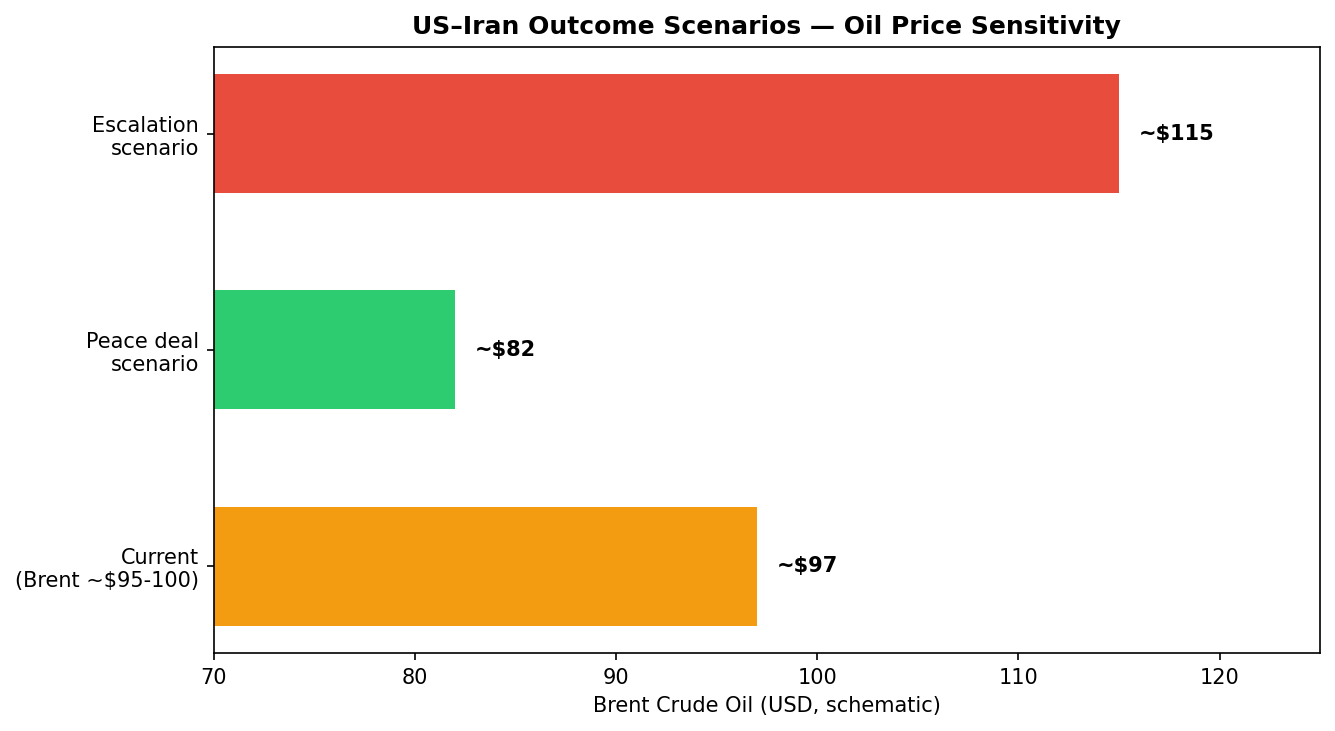
Brent Crude oil — schematic sensitivity to US–Iran outcomes. Source: market data
The fear-and-greed backdrop has improved from the extremes seen during the peak escalation phase, though the market retains a relatively short-term scope. Large institutional allocators appear cautious about adding risk ahead of the Fed, preferring to let the geopolitical and policy pictures clarify before committing fresh capital.
Fear-and-greed index from CNN. Source: https://edition.cnn.com/markets/fear-and-greed
The Fed decision on Wednesday
The centrepiece of the week is the FOMC meeting on June 16–17, with the rate decision and updated economic projections due on Wednesday, June 17 at 2:00 p.m. ET, followed by the press conference. This will be Kevin Warsh's first meeting as Fed chair, giving the event outsized importance for both the statement language and the dot plot.
Markets broadly expect the Fed to hold rates unchanged at the June meeting. CME FedWatch assigns a probability above 95% to no change on Wednesday. The real intrigue lies in the forward guidance: whether the Committee acknowledges the resilience of the labour market and sticky inflation components, and whether the median dot continues to signal a higher-for-longer path — or even opens the door to rate increases later in 2026.
After the strong macro data earlier in the month, pricing for a near-term rate cut has been pushed out, with some market participants assigning a meaningful probability to a hike before year-end. The June SEP (Summary of Economic Projections) will therefore be scrutinised for any shift in the median dot, the inflation forecast and the unemployment projection. A hawkish surprise — even without an immediate rate move — could pressure duration-sensitive equities and revive dollar strength. A more balanced or dovish-leaning message, particularly from Warsh in the press conference, could support a continuation of the risk-on regime that the SpaceX IPO helped reinforce.
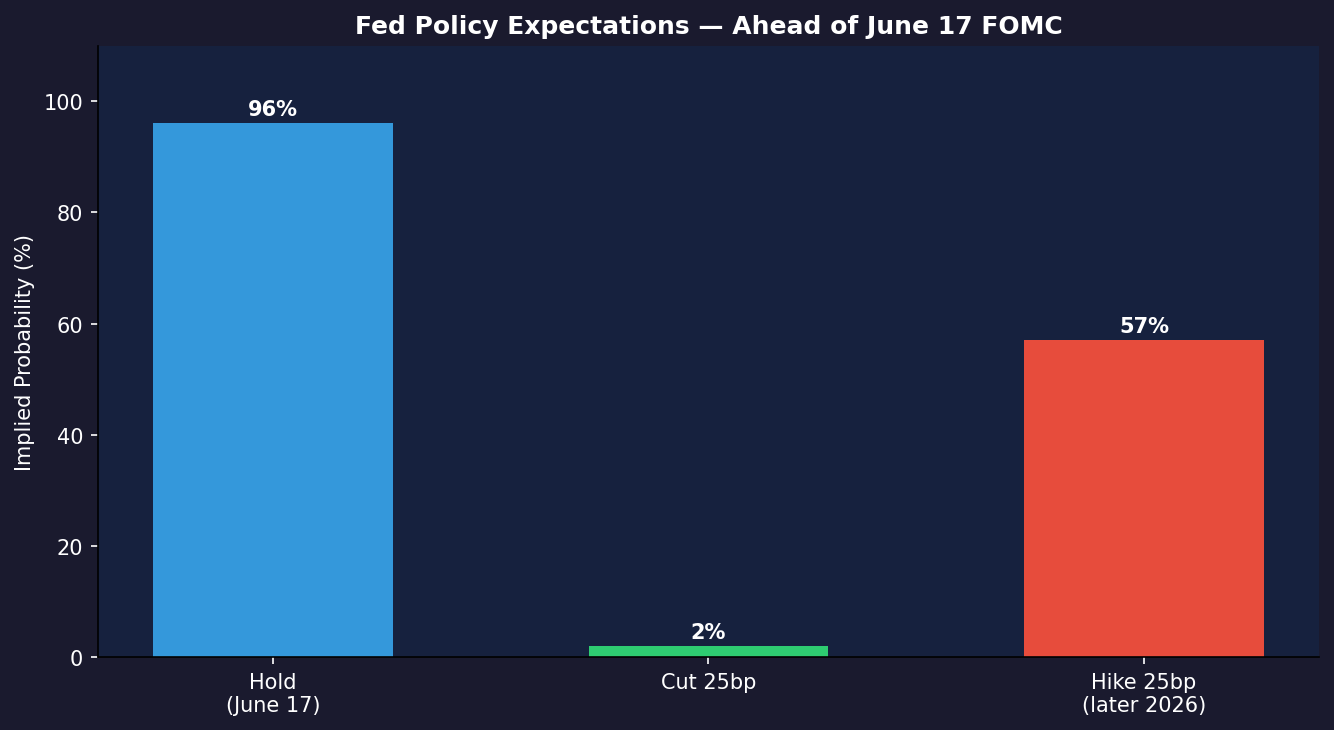
Fed policy expectations — ahead of June 17 FOMC. Source: CME FedWatch Tool
CME FedWatch Tool. Source: https://www.cmegroup.com/markets/interest-rates/cme-fedwatch-tool.html
FED's balance sheet. Source: https://www.federalreserve.gov/monetarypolicy/bst_recenttrends.htm
The policy decision arrives at a delicate intersection: equity markets are riding IPO-driven enthusiasm and AI momentum, while the bond market continues to price a more restrictive path than was expected just weeks ago. The correlation between stocks and bonds — which had offered diversification in prior cycles — remains under pressure, meaning a hawkish Fed reaction could transmit quickly across both sides of the portfolio.
News in focus this week
Monday, June 15: US Empire State Manufacturing (Jun) — early read on industrial activity ahead of the Fed.
Tuesday, June 16: US Retail Sales (May) — consumer demand pulse; FOMC meeting begins.
Wednesday, June 17: FOMC rate decision, dot plot and press conference — dominant event risk for all asset classes.
Thursday, June 18: US Jobless Claims — labour market follow-through after the Fed.
Friday, June 19: US markets closed for Juneteenth.
Now let's shift to potential scenarios and trading ideas for the week ahead, covering the post-IPO landscape, the Iran diplomacy wildcard and the Fed decision on Wednesday.
USOIL
Crude oil remains the most direct expression of the US–Iran narrative. With Brent trading in the $95–100 range, the market is pricing a meaningful but not extreme geopolitical premium. If weekend diplomacy continues to point toward a peaceful agreement, oil may face gradual pressure toward the $85–90 zone as hedges are unwound.
From a technical perspective, a break below the intermediate support area near the 20-day moving average could accelerate the decline, particularly if the Fed statement on Wednesday does not reignite inflation fears via a hawkish energy-cost channel. Conversely, any breakdown in talks would likely push Brent back above $100 quickly, reviving the volatility regime that had characterised the prior escalation phase.
Given the binary nature of the geopolitical catalyst, shifting to a smaller timeframe or reducing exposure ahead of headline risk may be prudent until the diplomatic picture clarifies.
USOIL, daily chart. Source: Exness.com
NAS100 (Nasdaq)
The Nasdaq enters the week with dual tailwinds and a single large headwind. The SpaceX IPO has reinforced the AI-and-innovation narrative, with SPCX potentially drawing incremental flows into the broader tech complex through index-rebalancing expectations. At the same time, the index must digest the hawkish macro backdrop and the Fed decision on Wednesday.
A constructive scenario assumes a hold at the June meeting, combined with balanced forward guidance that does not aggressively reprice hike odds higher. In that case, the Nasdaq may continue to trade in a rotational uptrend, with dip-buying emerging on any pre-Fed wobble — particularly in AI-linked names and recent IPO beneficiaries.
The risk scenario is a hawkish dot plot or press-conference tone from Warsh that pushes the 2-year yield higher and compresses growth multiples. In that case, the index may retest the 21,600–21,800 support zone before stabilising. The SpaceX debut has added liquidity and attention to the Nasdaq, but it does not insulate the index from a macro-driven repricing if the Fed surprises to the hawkish side.
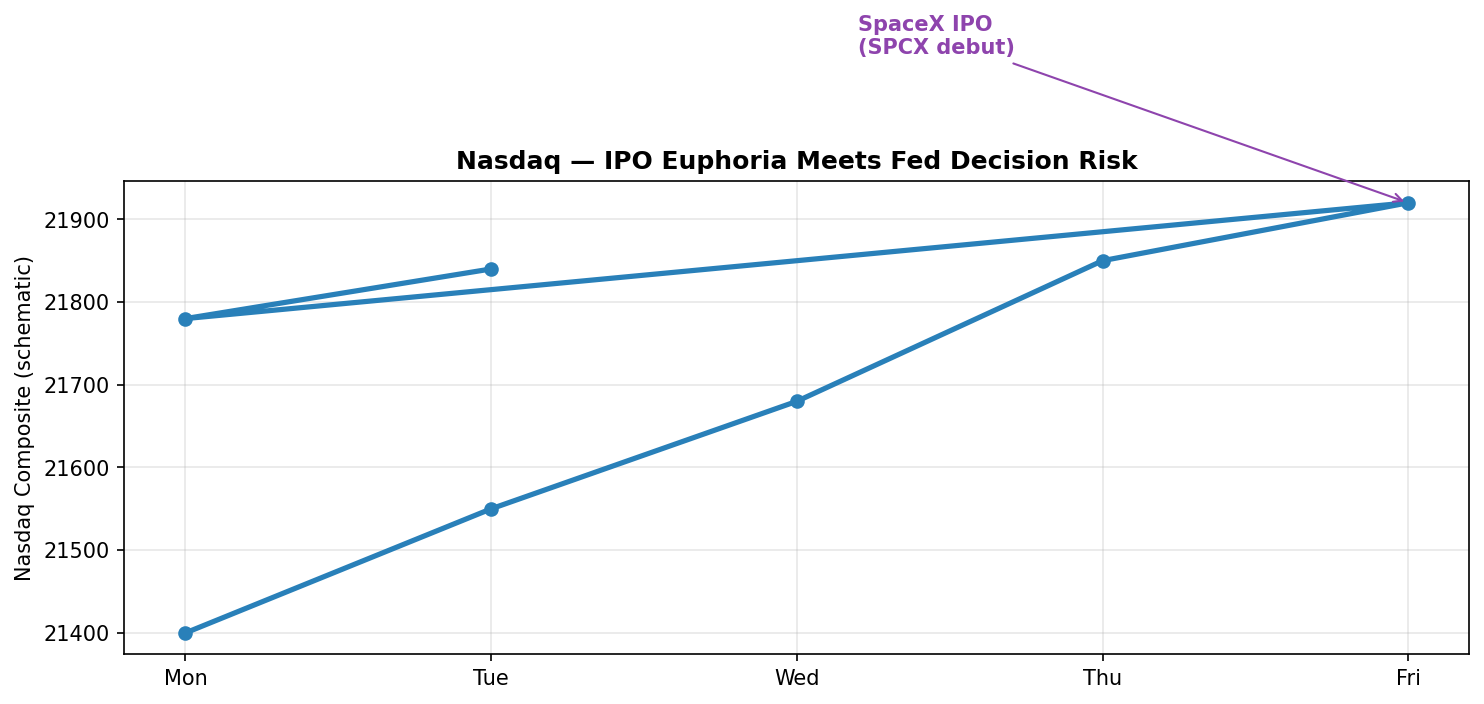
Nasdaq Composite, daily. IPO euphoria meets Fed decision risk. Source: Exness.com
XAUUSD
Gold has been caught between two competing forces. On one side, the possibility of a US–Iran peaceful agreement reduces the geopolitical hedge bid. On the other, sticky yields and a resilient dollar — reinforced by hawkish Fed expectations — continue to weigh on non-yielding assets.
If diplomacy progresses and the Fed holds without a hawkish surprise, gold may find responsive buying near the $4,250–4,300 area, where the 50-day moving average and prior consolidation converge. A failure of peace talks combined with a hawkish Fed could push XAU/USD toward the $4,150–4,200 zone as real yields rise.
The metal is unlikely to develop a strong directional trend until both catalysts — Iran and the Fed — have passed. Until then, a range-bound rotational price action with limited volatility seems the more probable regime.
XAUUSD, H4 chart. Source: Exness.com
Disclaimer: This material is for informational and analytical purposes only. It does not constitute investment advice, a recommendation, or a solicitation to trade. Financial markets involve substantial risk of loss. Past price behaviour and scenario analysis do not guarantee future results. All trading decisions remain the sole responsibility of the reader.