3 September 2026
Jobs surprise takes the hike off the table — CPI decides the rest
The first week of September opened defensively, with equities still nursing the damage from Jackson Hole, where Warsh's tough talk had pushed September hike odds toward 60% and flattened the curve. By Wednesday that had reversed: Governor Waller broke ranks and argued the Fed could hold, and the S&P 500 and Nasdaq posted their strongest session in weeks. As Bloomberg noted, markets treated Waller as the first crack in the hawkish bloc.
Friday complicated the story. Nonfarm payrolls rose 162,000 in August against a consensus near 55,000 — above every estimate in the Bloomberg survey — with May and June revised up by a combined 55,000. Unemployment held at 4.1% even as participation climbed to 61.6%. The "too weak to hike" argument disappeared, but average hourly earnings at +0.3% m/m and 3.1% y/y gave the Fed no wage-inflation excuse either. Odds of a September hike settled near 45%, and everything now rests on Wednesday's CPI.
Wednesday–Friday: Waller, jobs, and the stalled rally
Wednesday's rally was communication-driven. Waller's case for a hold landed into a market positioned for the opposite, and rate-sensitive names led the bounce while 10-year yields slipped. Equities recovered most of the Jackson Hole loss in a single session.
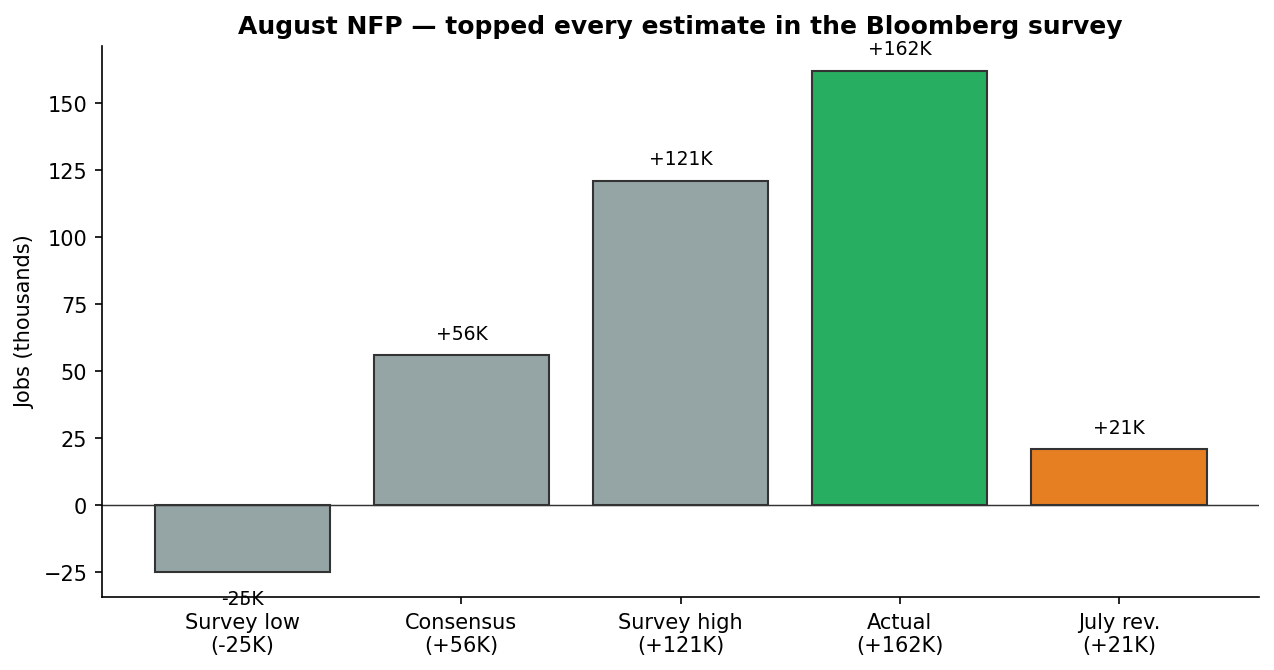
US NFP publications vs consensus forecasts. Source: https://tradingeconomics.com/united-states/non-farm-payrolls
Friday's print flipped the reaction function. Leisure and hospitality added 62,000 jobs and local government education another 42,000, while the household survey showed employment up 569,000 against a 683,000 rise in the labor force. A labor market this healthy removes the growth-scare argument for cutting, yet the absence of wage pressure removes the urgency to hike. Stocks gave back part of Wednesday's gain, gold eased, and yields finished the week roughly where they started.
The CPI week
The upcoming week might be formative, as August's CPI print (Wed, Sep 9, 8:30 ET) is the last major input before the FOMC. With payrolls strong and wages contained, the inflation number becomes the single variable that resolves the hike debate: it either validates Waller's hold and extends Wednesday's rally, or hands Warsh the case he has been building since Jackson Hole.
Consensus points to +0.2% m/m headline, +0.3% m/m core.
The Setup:
Hot Print: Pushes September hike odds back above 60%, caps gold at range highs and sends equities back toward the August lows.
Soft Print: Confirms the hold, puts hike odds below 35% and clears the resistance band on the Nasdaq.
News in focus — the week of September 7 - 11
Wednesday, September 9: August CPI — high impact.
Thursday, September 10: August PPI; weekly jobless claims.
Friday, September 11: University of Michigan sentiment and inflation expectations.
Ongoing: Fed speakers in the pre-FOMC window; Treasury buyback schedule.
Now let's shift to potential scenarios and trading ideas for the week ahead.
Gold
XAUUSD is rebuilding after the Jackson Hole flush, holding above the $4,450 shelf but unable to clear $4,550, where the August breakout attempt failed. The price is compressing against the 20-day moving average with declining range — a consolidation structure rather than a trend. The possible scenario for a trade is a breakout momentum entry above $4,550 on a soft CPI, targeting the $4,650–4,700 expansion area, with the range low invalidating the idea.
A hot print works the other way: it revives the hike trade, lifts real yields and would likely push gold back into the $4,380–4,420 zone. Positioning is light after the Jackson Hole shakeout, which argues for a sharper move in either direction once the number lands.
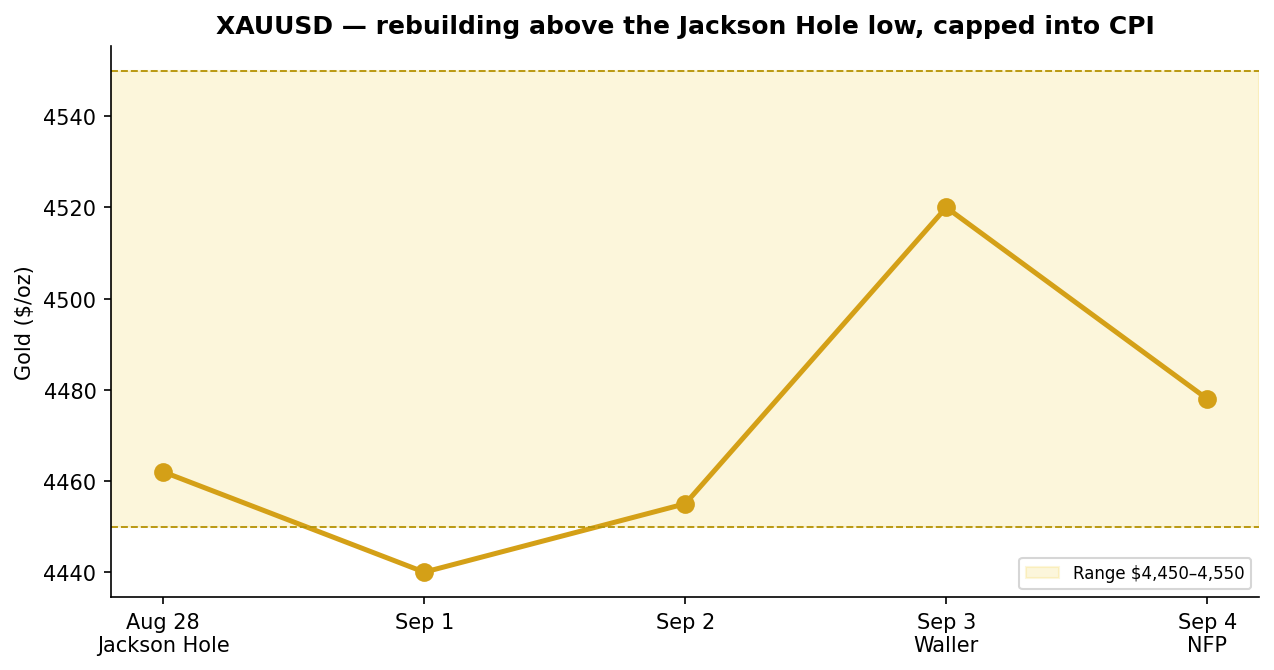
XAUUSD, 4-hour chart. Source: Exness.com
USTEC
The Nasdaq at 26,507 sits just under the 26,600–26,800 resistance band that has capped every attempt since the July AI de-rating. Wednesday's Waller bounce reached it and stalled, and Friday's jobs number was not enough to force a break. The index needs to hold 26,200–26,400 to keep the bullish case alive and target 27,000+ on a soft CPI.
Though, the repeated failures at the same level make an upside resolution less probable than a rotation lower, and a hot CPI would likely open the path toward 25,800–26,000, as shown on the chart.
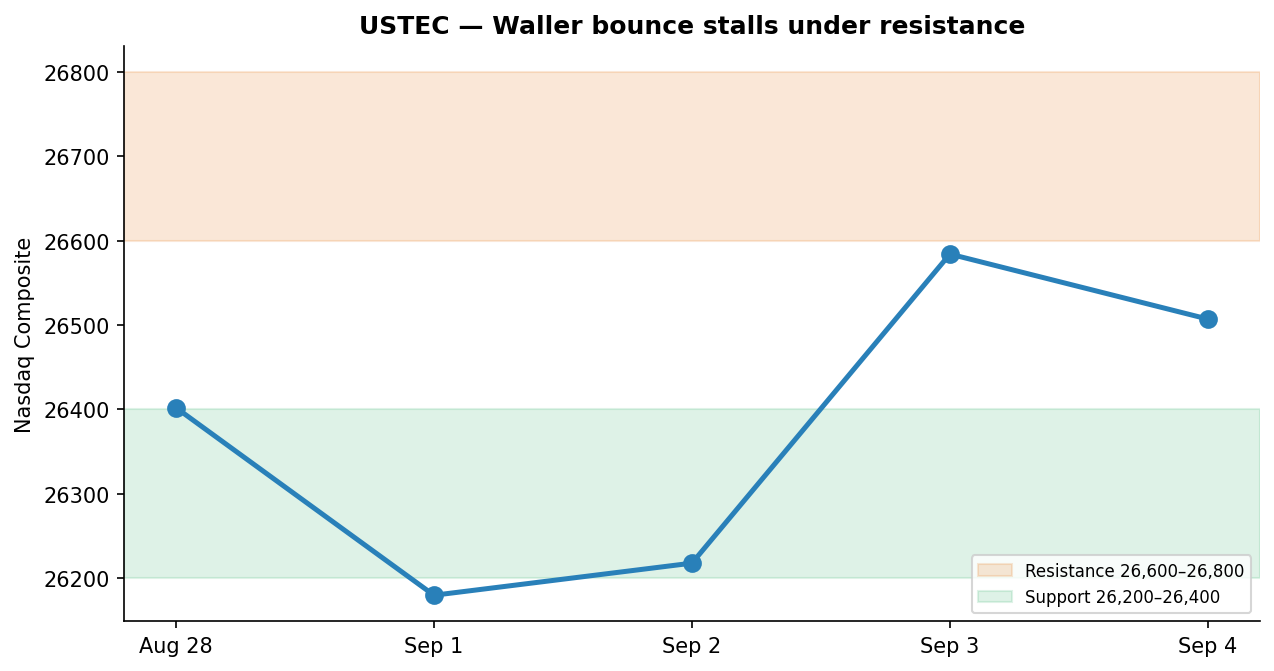
USTEC, 4-hours chart. Source: Exness.com